
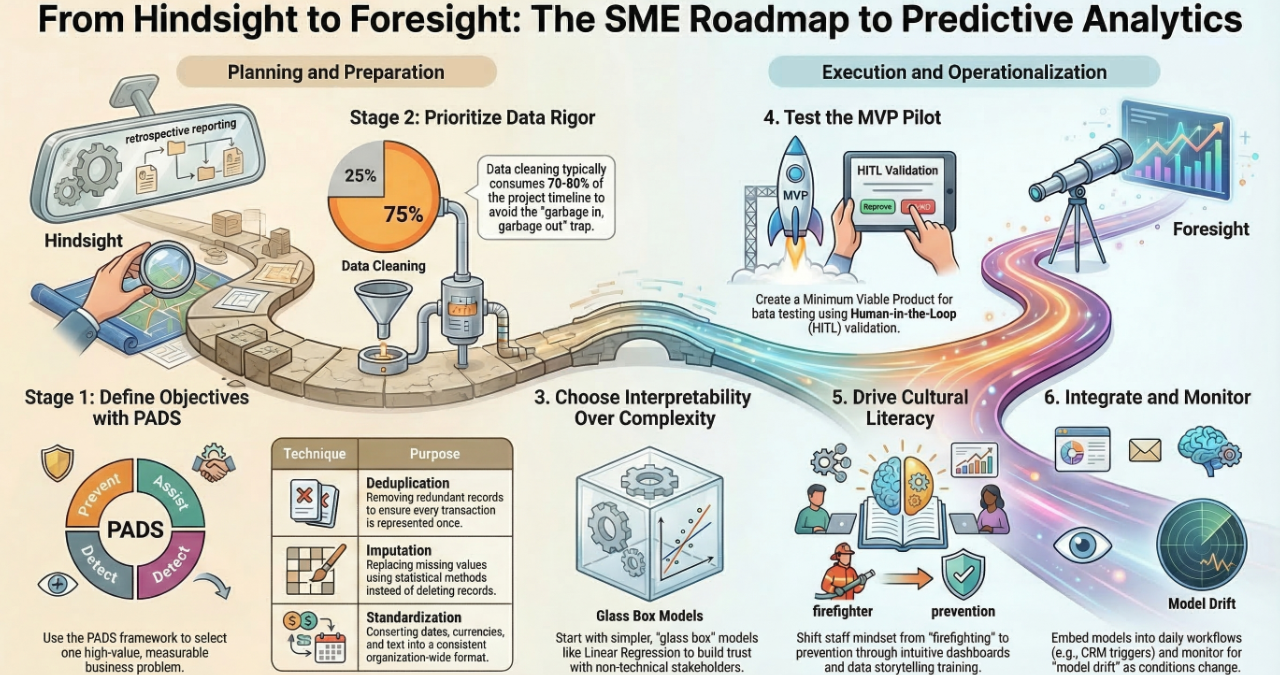
In the relentlessly competitive UK digital landscape 2026, simply understanding what happened yesterday is no longer a viable strategy for winning tomorrow. We are navigating an era where data is expanding at an unprecedented rate, yet raw data remains mere "potential energy" until it is converted into kinetic business action.
For many Small and Medium Enterprises (SMEs), the transition from traditional Business Intelligence (BI), which answers "what happened", to Predictive Analytics which forecasts "what is likely to happen", can feel like a technical chasm. However, empirical research indicates that SMEs leveraging predictive insights experience revenue growth rates up to 123% higher than the industry average.
This guide provides a structured, phased roadmap to help your organisation navigate its first predictive project, ensuring it serves as a scalable foundation for long-term strategic resilience.
Stage 1: Defining Objectives with the PADS Framework
The most pervasive cause of failure in initial projects is the lack of a clearly defined, high-ROI business problem. SMEs must resist the urge to "mine all data" in hopes of finding a "golden nugget". Instead, use the PADS framework to identify your objective:
Stage 2: Data Collection & Preparation
Predictive models are only as reliable as the data they ingest. For SMEs, this means gathering relevant data from CRM systems, ERP software, and even external sources like social media sentiment or weather patterns.
However, raw data is almost always "messy." Data cleaning often consumes 70% to 80% of a project’s timeline. To avoid the "garbage in, garbage out" trap, you must implement these essential techniques:
Stage 3: Choosing Tools & Models
You do not need an army of data scientists to begin.
Stage 4: Pilot Testing and "MVP" Approach
Before a full-scale rollout, conduct a pilot test to create a Minimum Viable Product (MVP). Create a rapid proof of concept and give it to a small group of end-users for "beta testing". Test your model against a reasonably high accuracy threshold. For customer-facing sectors, focus on Human-in-the-Loop (HITL) validation, where staff can "confirm" an AI prescription to improve future machine learning accuracy.
Stage 5: Training and Cultural Transformation
No information is valuable in a vacuum; it must be actionable. Employee resistance is a common barrier, often rooted in a fear of displacement.
Stage 6: Integrate and Use
The final frontier is operationalisation; embedding your model into day-to-day business processes.
The Path Forward
The time to stop steering your business solely by looking in the rearview mirror is now. By unifying your reporting with algorithmic foresight, you empower every decision-maker to operate with the future in mind, turning your data into a true engine of strategic growth. Ready to start? Begin with one business problem, invest in a clean data foundation, and remember: "perfect is the enemy of good"; an 80% accurate model today is worth more than a 100% accurate model that is never implemented.
Sources include:
Leveraging Predictive Analytics and AI for SME Growth, World Journal of Advanced Research and Reviews
Data Quality Thresholds That Align With Business Impact, Gartner
Predictive Analytics AI, Cisco