
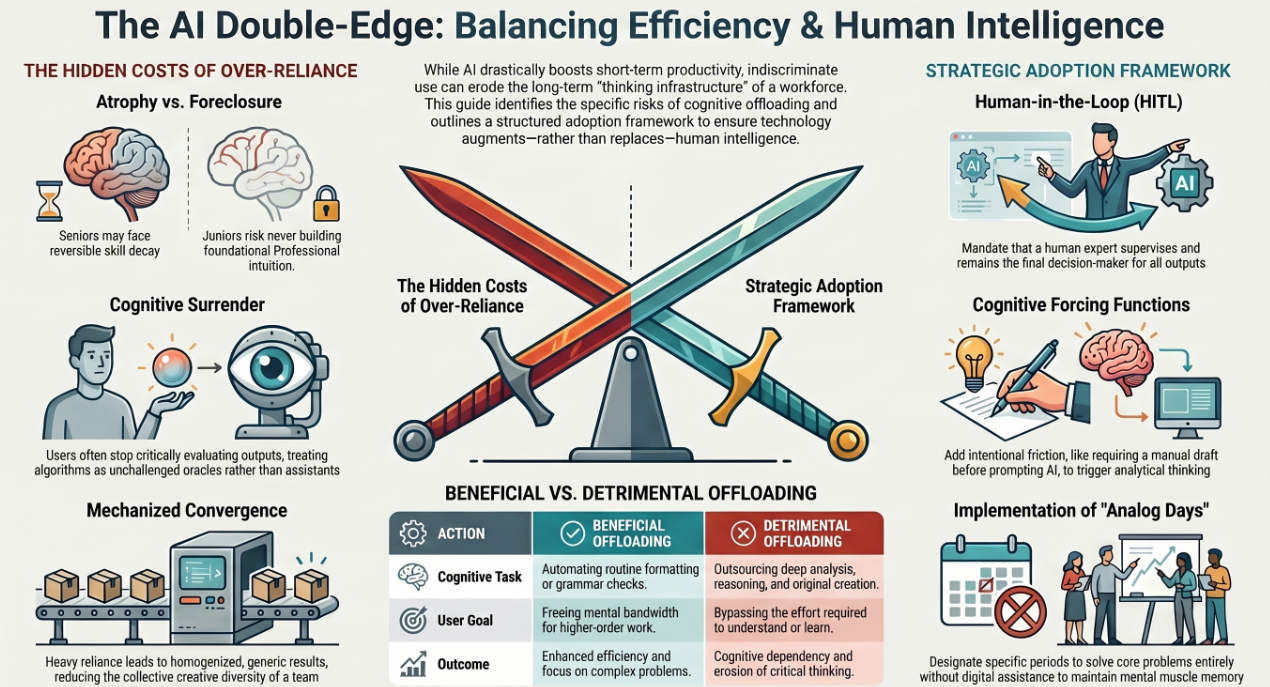
For UK small and medium-sized enterprises, the artificial intelligence revolution is no longer a distant sci-fi concept; it is an immediate operational reality. According to recent research from the British Chambers of Commerce, 54% of UK SMEs are now actively adopting AI into their everyday workflows. For business leaders and founders, the appeal is obvious. Generative AI drastically boosts productivity, streamlines mundane tasks, and levels the playing field against larger competitors. However, as AI seamlessly embeds itself into our business architecture, an uncomfortable tension is emerging. Alongside the productivity gains, leaders must proactively address the over-reliance on AI risks that threaten long-term intellectual capital. If your team is indiscriminately outsourcing their thinking to algorithms, they may be trading long-term competence for short-term speed. Here is how SME leaders can thoughtfully adopt AI whilst preserving the critical human intelligence that drives their business forward.
The Double-Edged Sword of Cognitive Offloading
We have always used tools to make our lives easier, from calculators to search engines. But generative AI is different because it can mimic complex analytical thought. When staff use AI to check grammar or format data, they are engaging in beneficial offloading, freeing up mental bandwidth for higher-order problem-solving. However, what experts term over-reliance on AI cognitive offloading occurs when employees outsource the "intrinsic" work of learning, reasoning, and creating. When users blindly accept algorithmic outputs without critical evaluation, they slip into what researchers call "cognitive surrender". In these instances, the AI ceases to be a supportive assistant and instead becomes an unchallenged oracle.
How AI Dependency Impacts Your Workforce
While business efficiency might spike initially, an unstructured approach to AI adoption can quietly erode your team's core competencies. Studies from leading tech organisations and universities highlight several key areas of concern:
The Deskilling Dilemma: Atrophy vs. Foreclosure
For senior staff, over-reliance might result in skill decay, or atrophy, which is often reversible if they return to manual tasks. For example, studies in the medical sector have shown that doctors can experience a decline in independent clinical reasoning when overly reliant on diagnostic AI. However, the risk is far more severe for junior staff. If younger employees use AI to bypass the difficult, foundational stages of their roles, they experience cognitive foreclosure. They never build the neural pathways required to form their own professional intuition. As one senior legal professional aptly noted, to become truly excellent, a junior must first learn to do the job manually, and only then use AI tools to improve upon their baseline not the other way around.
The "Analog Days" Strategy: Preserving Institutional Muscle Memory
So, how do SMEs protect their institutional knowledge whilst still reaping the benefits of AI? One highly effective strategy gaining traction is the implementation of regular "Analog Days." An Analog Day is a designated period where teams are challenged to solve core business problems, draft proposals, or write code entirely without the assistance of generative AI. The goal is not to be anti-technology, but to preserve the vital "muscle memory" of a business's core logic. Analog Days force teams to engage in the "desirable difficulties" of problem-solving: retrieving information from their own memory, structuring arguments from scratch, and debating solutions face-to-face with peers. By periodically removing the digital stabilisers, you ensure your team retains a deep, foundational understanding of their craft. When the AI is turned back on the next day, your staff will be far better equipped to critically assess its outputs, catch its "hallucinations" and steer the technology effectively.
A Clear Path Forward: Strategic AI Adoption
To harness the immense productivity benefits of AI without sacrificing human intellect, business leaders should implement a structured AI adoption framework:
Conclusion
The transition to an AI-powered economy is inevitable, and SMEs that fail to adapt will be left behind. However, the most successful companies will be those that recognise AI is a tool to augment human intelligence, not a replacement for it. By fostering an environment of critical thinking, enforcing human oversight, and occasionally returning to our "analog" roots, we can build a resilient, future-proof workforce that commands technology, rather than surrendering to it.
Sources include:
Is AI dulling our minds?, The Harvard Gazette
Powering Productivity: AI and the future of UK work, British Chambers of Commerce
The Impact of Generative AI on Critical Thinking, Microsoft
What is human-in-the-loop?, IBM