
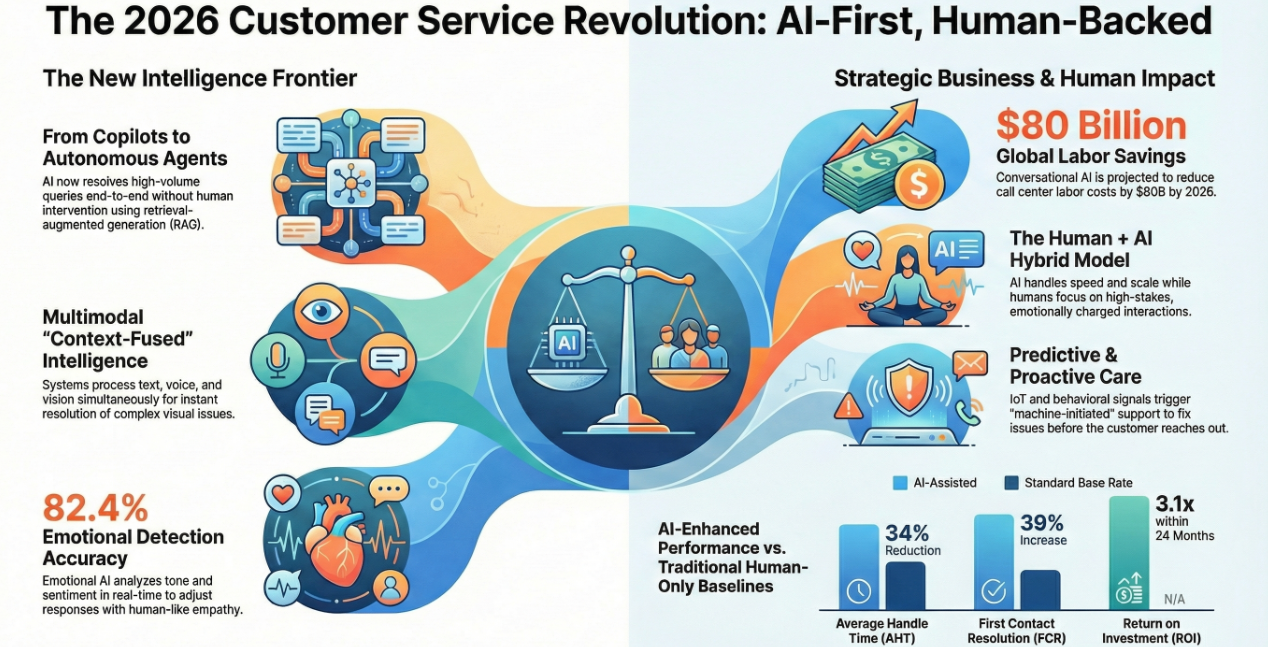
The customer service landscape has moved far beyond the experimental phase, establishing itself as the operational spine of the modern enterprise. Not long ago, the industry was buzzing about the potential of simple chatbots; today, we are witnessing a fundamental structural metamorphosis from reactive, human-centric models to autonomous, intelligence-driven architectures. By 2023, research already indicated that 70% of customer interactions involved emerging technologies like machine learning and mobile messaging. As we move through 2026, this integration is becoming absolute, with experts predicting that AI will eventually play a role in 100% of customer interactions, either as a primary interface or a vital underlying support layer for human agents.
The Economic Case for Intelligence
The financial impetus for this transition is no longer just about "saving pennies"; it is about systemic survival. While earlier data showed annual savings of roughly $8 billion for businesses using AI, more recent analysis suggests the impact is even more profound. Organisations implementing advanced AI-driven automation report cost reductions of up to 25%, while simultaneously recording a 23% reduction in customer churn rates. Mature AI adopters are finding that these systems don't just cut costs; they deliver an average 3.1x return on investment within 24 months of deployment. This efficiency stems from the ability of modern AI to resolve up to 80% of routine inquiries without any human intervention at all.
From Simple Chatbots to Autonomous Agents
We have seen a significant architectural shift from the rigid, "press 1 for help" scripted bots of the past to Agentic AI. Unlike legacy systems, modern autonomous agents can independently prioritise tasks, solve challenges, and even coordinate with other backend systems to complete multi-step workflows. For example, if a customer’s flight is cancelled, an autonomous agent doesn't just provide information; it can proactively identify the delay, assess alternative routes, and finalise a rebooking before the passenger even reaches the airport. This transition from reactive ticket-handling to predictive care is becoming the new gold standard for brand loyalty.
The Multimodal Personalisation Revolution
The most striking advancement in 2026 is the rise of Multimodal AI, which replaces the traditional "omnichannel" standard. While omnichannel was about being present on every platform, multimodality allows AI to understand text, voice, images, and video simultaneously within a single conversation.
Imagine a customer who can type a message, share a voice note, and upload a photo of a damaged product in the same chat interface. The AI doesn't just receive these files; it understands them holistically, using computer vision to identify product defects instantly and sentiment analysis to detect the customer's frustration in their tone. When these systems are backed by a Customer Data Platform (CDP), they create a "single customer view" that ensures every interaction is hyper-personalised to the individual’s history and current needs.
Balancing Technology with Human Empathy
Despite these technological leaps, the "human touch" remains indispensable. Approximately 59% of consumers still feel that companies can lose touch with the human element of the experience. The industry’s answer is the "Human-plus-AI" model, where AI handles the routine and repetitive, while human agents manage high-stakes, emotionally charged situations. New "Connected Rep" technology is bridging this gap, providing human agents with real-time summaries and suggested solutions, which can improve contact centre efficiency by up to 30%. Furthermore, Emotional AI can now detect subtle signals in a caller's voice with 71.8% accuracy, allowing for seamless escalation to a human agent the moment a customer becomes genuinely agitated.
Governance, Ethics, and the Way Ahead
As AI takes on high-stakes roles, such as determining creditworthiness in banking or providing healthcare guidance, robust governance has become a regulatory requirement. With the full implementation of the EU AI Act in August 2026, transparency is no longer optional. Businesses must now proactively disclose when customers are interacting with AI and ensure that their models are regularly audited for bias.
The future trajectory of customer service is clear: it will be smarter, faster, and more intuitive. By 2028, it is predicted that 15% of all day-to-day work decisions will be made autonomously by AI agents. For organisations, the challenge is no longer whether to adopt AI, but how quickly they can integrate it responsibly to turn customer service from a cost centre into a strategic growth engine.
Sources include:
AI in Customer Service, IBM
AI Customer Service Statistics for 2026, Zendesk
The State of AI in the Enterprise, Deloitte US