From Trendspotting to Trust: The Next Frontier of Retail Predictive Intelligence
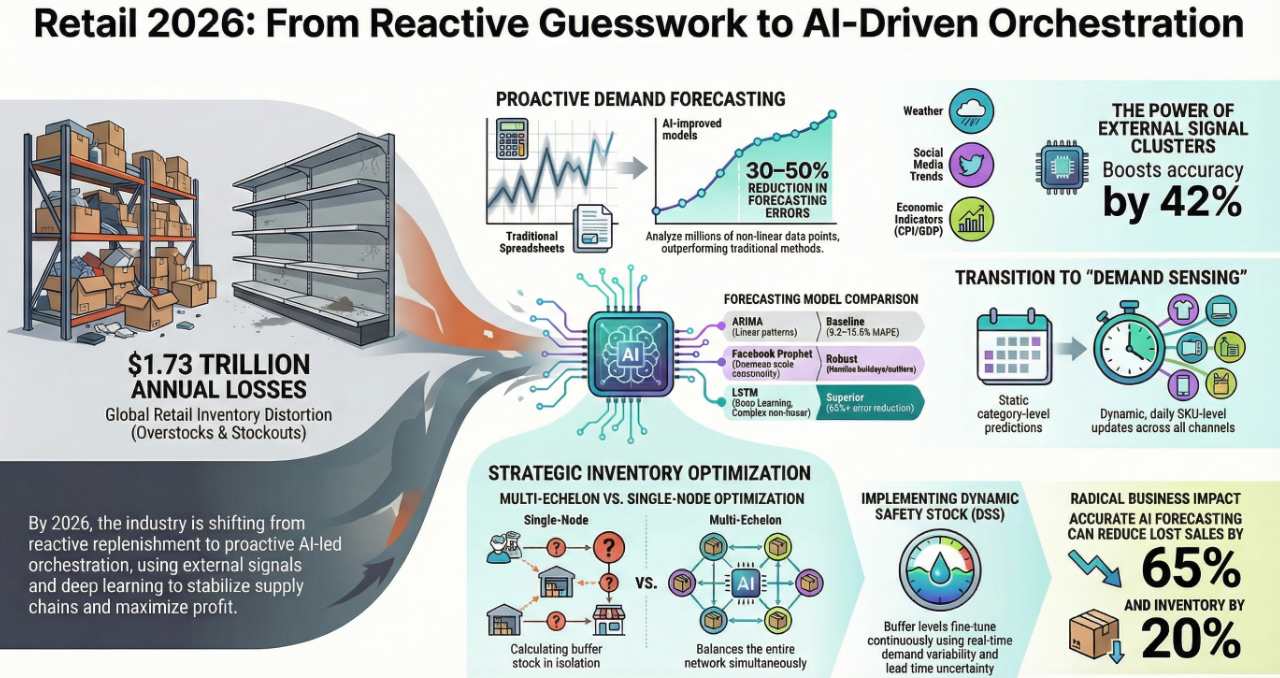
In the relentlessly competitive retail landscape of 2026, simply reacting to yesterday’s sales figures is no longer a viable strategy for winning tomorrow. The global retail industry continues to struggle with inventory distortion—a combination of overstocking and stockouts that results in a staggering $1.73 trillion in annual losses. In this climate, raw data is merely potential energy; the true market leaders are those capable of converting that potential into kinetic, proactive business action. Traditional Business Intelligence (BI) has long served as a "system of record", providing descriptive reports on past performance. However, forward-thinking organisations are now bridging the gap between retrospective analysis and future estimation by integrating Predictive Analytics into unified data ecosystems. This evolution shifts the organisational posture from reactive firefighting to a proactive strategy that anticipates market shifts, social media-driven demand surges, and operational risks before they manifest.
The Spectrum of Intelligence: A Maturity Journey
To truly leverage predictive BI, retailers must view their progress through the lens of an Analytics Maturity Model. This is not merely about adopting new software; it is a structured progression in how an organisation handles information:
- Descriptive (Hindsight): Answers "What happened?" via standard KPIs and store-level dashboards.
- Diagnostic (Insight): Explores "Why did it happen?" using root-cause analysis and correlation between factors like weather and footfall.
- Predictive (Foresight): Asks "What is likely to happen?" by applying machine learning to identify hidden patterns in consumer behaviour.
- Prescriptive (Optimisation): Recommends "What should we do about it?" by simulating "what-if" scenarios to find the best course of action.
- Cognitive / AI (Autonomy): The pinnacle where systems achieve autonomy, such as AI shopping assistants that perceive, learn, and adapt in real-time with minimal human intervention.
Building a Resilient Predictive Architecture
Transitioning to predictive capabilities does not require discarding existing tools; rather, it involves enriching them through a more sophisticated architecture.
- Breaking Down Data Silos: Fragmentation across departments blocks real-time visibility. Modern retailers are consolidating data across POS, CRM, and ERP systems to create a "single version of the truth".
- The Shift from ETL to ELT: Modern cloud-native environments favour Extract, Load, Transform (ELT). By loading raw data first and transforming it "in-place", organisations preserve original data integrity, which is vital for training evolving machine learning models.
- The Rise of the Lakehouse: Storage must balance the performance of structured BI with the flexibility needed for unstructured AI data. A Lakehouse architecture unifies these needs, allowing data engineers and scientists to work from the same reliable dataset.
The Three Pillars of Modern Forecasting
Choosing the right predictive model depends on the complexity of the data and the required forecasting horizon.
- ARIMA (Statistical): Tracing its origins to the 1970s, ARIMA excels at capturing linear trends and is ideal for short-term forecasting with stationary data.
- Prophet (Automated Trend Analysis): Designed for business-scale forecasting, Prophet simplifies the process by automatically handling seasonality, holidays, and missing data.
- LSTM (Deep Learning): Capable of learning long-term dependencies and complex non-linear patterns, LSTM often achieves the highest accuracy but requires substantial computational resources.
Technical Integration of External Signals
A major hurdle in modern analytics is making complex models accessible to frontline staff. By integrating real-time external signals, organisations can significantly refine predictive accuracy:
- Social Media Sentiment: Analysing engagement rates and sentiment scores on platforms like TikTok and Instagram can improve demand forecasting accuracy by up to 42%, particularly for new product launches without historical data.
- Macroeconomic Indicators: Incorporating metrics like the Consumer Price Index (CPI) and GDP growth helps align seasonal planning with the actual purchasing power of target demographics, potentially cutting inventory levels by 20% to 30%.
- Weather Patterns: Predictive weather analytics can help retailers cut overstock and stockouts by 20%, as weather influences up to 93% of consumer buying habits.
High-Impact Use Cases in Retail
- Demand Sensing & Inventory Optimization: Industry leaders like Walmart use AI to analyse sales, search trends, and weather to forecast demand at a granular store-item level, reducing stockouts by 30%.
- Agile Fast Fashion: Zara utilizes real-time sales data to inform 85% of its product manufacturing, allowing it to deliver new designs from concept to store in as little as two weeks.
- Personalised Customer Experience: H&M leverages AI-driven recommendation engines and virtual fitting rooms to provide tailored experiences, reducing return rates and increasing engagement.
Governance, Privacy, and the Path Forward
You cannot scale intelligence on top of chaos. Effective predictive BI requires a "culture of quality", where automated validation checks guard against the "garbage in, garbage out" trap. Furthermore, as privacy regulations like GDPR tighten, pioneers are looking toward Responsible AI Frameworks to ensure fairness, transparency, and the ethical use of customer data. The time to stop steering your business solely by looking in the rearview mirror is now. By unifying your reporting with algorithmic foresight, you empower every decision-maker to operate with the future in mind, turning your data into a true engine of strategic growth.
Sources include:
AI-Powered Demand Forecasting, Amazon AWS Executive Insights
H&M's AI Playbook: The Tech Strategy Behind Its Transformation, CTO Magazine
The Role of Predictive Analytics in Enhancing Financial Decision-Making and Risk Management, Scientific Research Publishing