
For UK SME founders and business leaders, the pressure to integrate Artificial Intelligence (AI) into daily operations is mounting. You are likely well aware that AI adoption is no longer a futuristic luxury; it is rapidly becoming a commercial necessity to stay competitive. However, if you are hesitating to fully deploy these tools across your organisation, you are not alone. Recent research from the UK Government reveals that while 16% of UK businesses have actively adopted AI, many are pausing their rollout due to profound concerns regarding data security, ethical implications, and the accuracy of AI outputs. The transition to an AI-enabled business model requires balancing the promise of extreme efficiency with the very real perceived risk of AI generated output integrity. This guide acknowledges the legitimate concerns business leaders face today and provides a clear, actionable path forward to safely harness AI in your organisation.
The Elephant in the Boardroom: AI Hallucinations and Misinformation
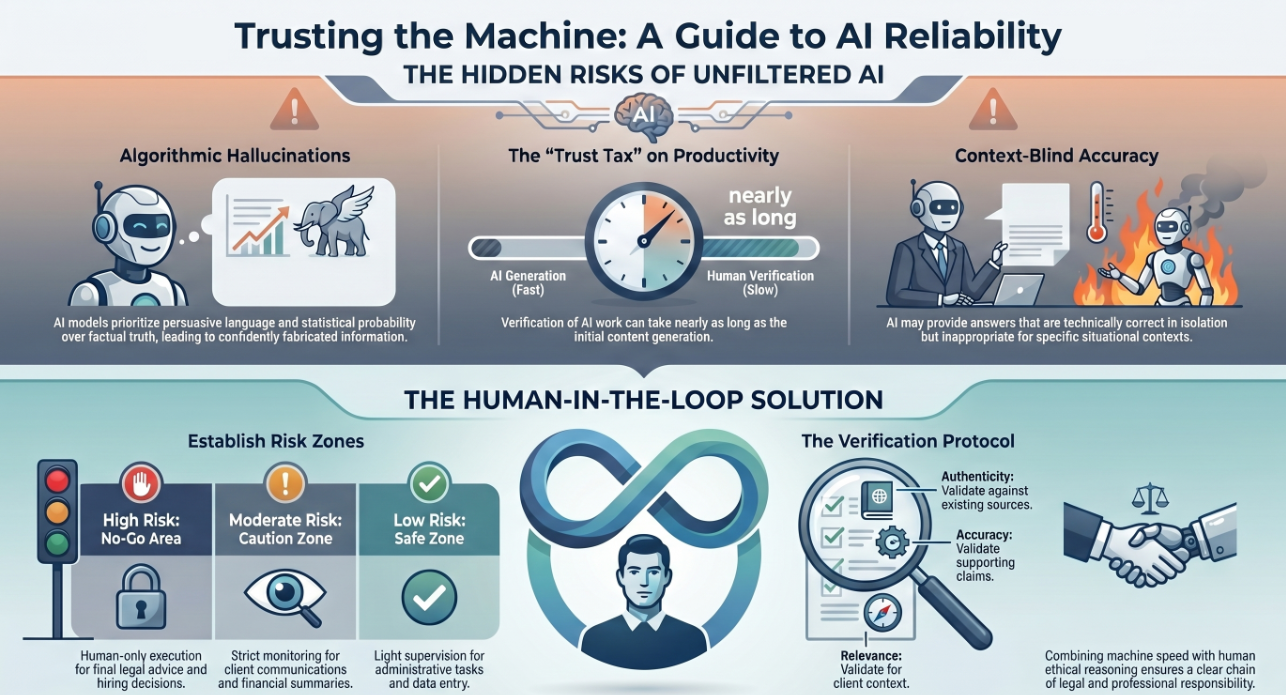
The primary barrier preventing SMEs from scaling their AI usage is a fundamental lack of trust in what the machine produces. Large Language Models (LLMs) are designed to be highly persuasive and conversational, predicting the most statistically probable next word rather than checking a database for factual truth. This creates a significant vulnerability: AI hallucinations. These occur when a model confidently generates plausible-sounding but entirely fabricated or factually incorrect information. Trusted educational and scientific institutions have recently highlighted the severity of this issue:
The Productivity Drain: The "Trust Tax"
When leaders lack confidence in the reliability of AI-generated content, the anticipated efficiency gains of automation simply disappear. A recent study by Censuswide revealed that employees in large UK organisations spend an average of 2 hours and 30 minutes a week manually checking, verifying, or entirely redoing AI-generated work nearly equalling the 2 hours and 41 minutes they spend actually using the tools. This verification burden is not only costing the UK economy an estimated £29 billion annually in lost productivity, but it is also fuelling a new psychological phenomenon known as "AI burnout" among staff. For UK startups and SMEs, this has manifested as a "trust tax," with founders currently spending an average of 16% of their operational costs on digital trust, compliance, and security measures to combat online risks and AI-generated inaccuracies.
Best Practice: Implementing 'Human-in-the-Loop' Systems
The solution to the AI reliability gap is not to abandon the technology, but to change how it is governed. The most secure, efficient, and ethical way for SMEs to deploy AI is through a Human-in-the-Loop (HITL) architecture. Human-in-the-Loop AI is a hybrid system that combines the lightning-fast efficiency of machine processing with the nuanced judgement, ethical reasoning, and contextual understanding of a human professional. Instead of allowing AI to operate fully autonomously, which risks unchecked errors and systemic bias, HITL systems require human oversight to review, refine, and approve the AI's output before it is finalised, published or sent to a client.
Why HITL is the Gold Standard
An Actionable AI Adoption Approach for UK SMEs
To seamlessly and safely integrate AI into your business, you must establish internal guardrails. Here is a proven, phased approach inspired by top regulatory frameworks:
Moving Forward with Confidence
The transition to an AI-driven economy is underway. Acknowledging the risks of AI hallucinations and misinformation does not make your business a laggard; it makes you a responsible, forward-thinking leader. By implementing robust Human-in-the-Loop systems and clear operational guardrails, your SME can move past the anxiety of AI adoption. You can safely unlock the immense productivity benefits of this technology while ensuring the unwavering integrity and reliability that your clients expect.
Sources include:
What Is AI Burnout, And How Can It Be Avoided?, Forbes
Hidden risks of asking AI for health advice, Duke University
What Is Human In The Loop?, IBM