Is Your Organization Ready for Predictive Analytics? A Maturity Assessment Framework
In the relentlessly competitive digital landscape of 2025 and 2026, simply understanding what happened yesterday is no longer a viable strategy for winning tomorrow. As the global artificial intelligence market is projected to soar toward £650 billion ($826 billion) by 2030, the pressure on organisations to achieve analytical maturity has shifted from a visionary goal to a core strategic imperative. However, the journey from reactive reporting to algorithmic foresight is complex, requiring a nuanced understanding of both readiness and maturity.
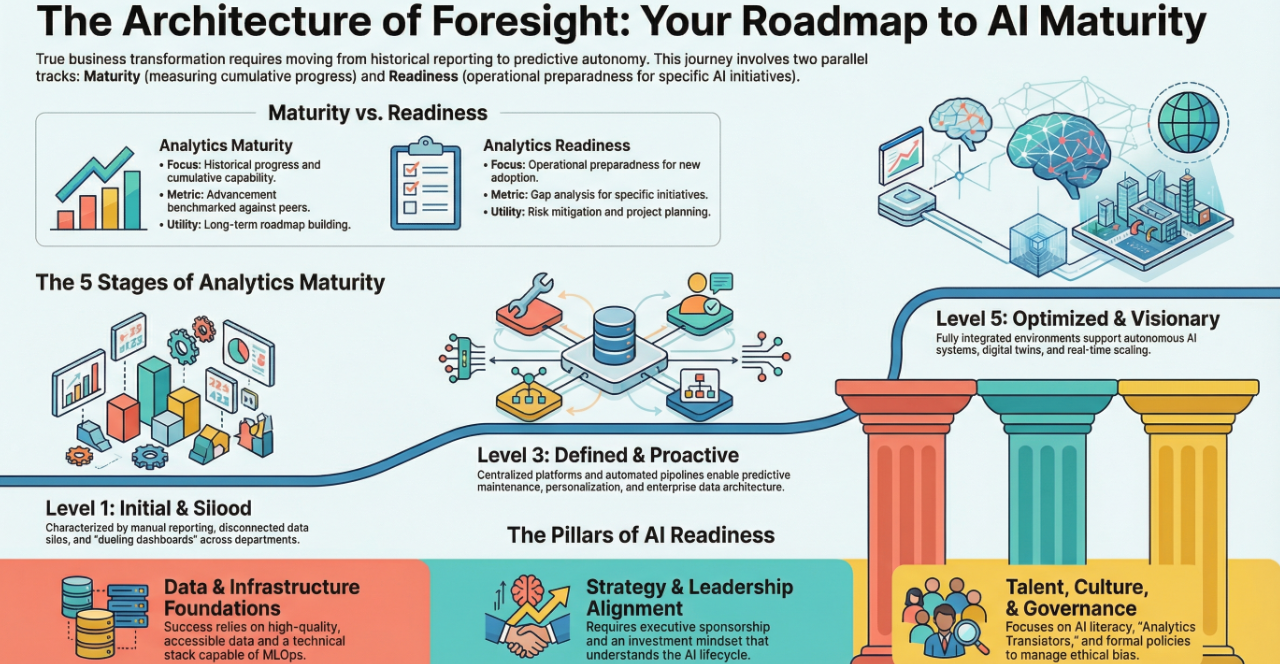
Maturity vs. Readiness: Knowing the Difference
To successfully navigate this transition, leaders must first distinguish between two critical concepts.
- Maturity: represents a retrospective measure of an organisation's cumulative progress; the "house" you have built over time across technical skills, financial planning, and data infrastructure.
- Readiness: is a forward-looking operational check. It asks whether your "launchpad" is actually prepared for a specific mission, identifying gaps like poor data quality or talent shortages before they become costly failures. Achieving true "analytical competitiveness" requires aligning these two forces to ensure the foundation is strong enough to support the next level of innovation.
The Spectrum of Intelligence: A Five-Stage Framework
Drawing from established industry standards like the DELTA Plus and Gartner models, we can categorise organisational progress into five distinct stages:
- Analytically Impaired (Aware): The organisation is "flying blind," relying primarily on gut instinct and intuition. Data is trapped in departmental silos, often resulting in "dueling dashboards" where different teams present conflicting figures for the same KPIs.
- Localized Analytics (Reactive): Pockets of analytical activity and "islands" of expertise emerge in specific areas like marketing or finance. Analysis remains largely descriptive, explaining past events rather than anticipating future ones.
- Analytical Aspirations (Proactive): Leadership recognises the value of data and begins to invest in centralised repositories and high-priority datasets. The organisation starts experimenting with its first predictive models, though enterprise-wide coordination is still lacking.
- Analytical Companies (Managed): Analytics becomes a corporate priority, with data strategies aligned to broader business goals. Advanced tools, such as machine learning platforms and IoT-driven pipelines, provide a "single source of truth" across departments.
- Analytical Competitors (Optimized): This is the pinnacle, where real-time, autonomous analytics lead the business rather than just supporting it. Systems achieve a level of autonomy, simulating human thought processes to make real-time decisions with minimal intervention.
The Readiness Checklist: Is Your Foundation Solid?
Before scaling your predictive initiatives, you must assess your readiness across these critical dimensions:
- Data Quality and Depth: You cannot scale intelligence on top of chaos. A solid foundation typically requires 12 to 18 months of clean, historical data to train a model to recognise meaningful patterns.
- Technical Infrastructure: Modern storage must balance performance with flexibility. Many organisations are moving toward a Lakehouse architecture to provide a single source of truth for both analysts and data scientists.
- The "Translator" Role: Success requires more than just data scientists. You need Analytics Translators; liaisons who can bridge the gap between technical experts and business departments to ensure models solve real-world problems and are actually adopted by frontline staff.
- Leadership and Culture: Readiness at the executive level requires an "investment mindset" that understands analytics often requires a period of experimentation before yielding ROI. Employees must see AI as a capability multiplier rather than a job threat.
Governance and Ethics: Avoiding the "Black Box" Trap
As predictive models influence high-stakes decisions like loan approvals or patient care, ethical implications become paramount. Organisations that ignore algorithmic bias or model transparency risk "ethical debt"; a build-up of legal and reputational risks that can lead to a permanent loss of stakeholder trust. A mature framework must prioritise explainability, using tools to ensure that when a model makes a prediction, the logic behind it is clear and defensible.
Moving Forward
Transitioning to predictive capabilities is a marathon, not a sprint. By using a structured maturity model to identify your current position, you can stop steering your business by looking in the rearview mirror. By building a foundation of high-quality data and a literate workforce, you transform your organisation from a reactive observer of the past into a proactive architect of its own future.
Sources include:
Achieving Big Data Analytics Maturity, TDWI
Data Literacy: Enhance the Value of Your Data Assets, Gartner
DELTA Plus Model and 5 Stages of Analytics Maturity, International Institute for Analytics