Guide to AI, Data Privacy, and Intellectual Property
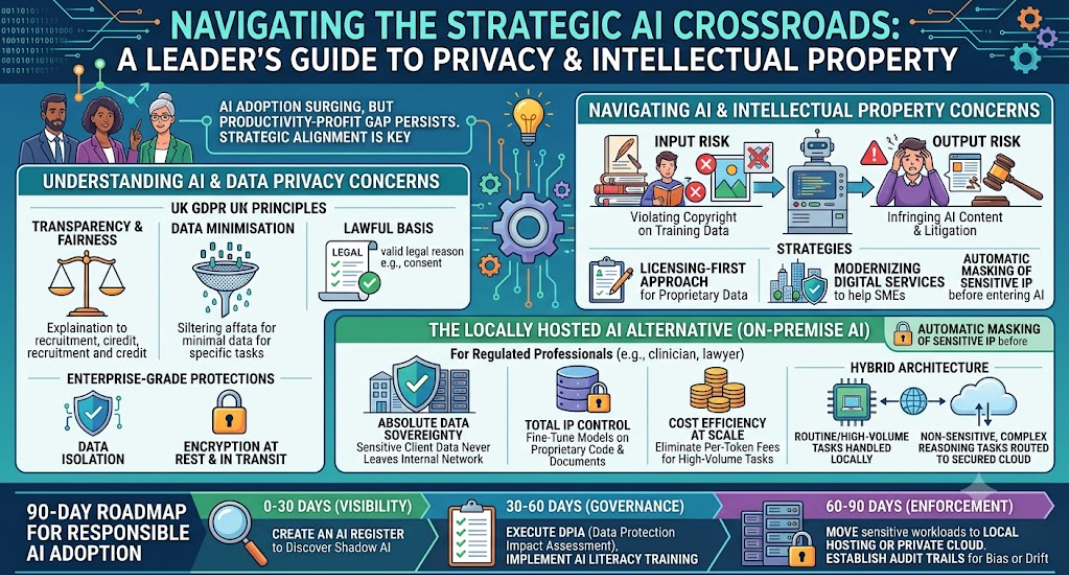
Artificial Intelligence has moved from the experimental fringes to a structural economic imperative for UK businesses. As of early 2026, active adoption among small and medium-sized enterprises has surged to over 50%. However, a significant "productivity-profit gap" persists: while many are "plugging in" the technology, only 12% of AI-using firms report measurable revenue increases.
This gap often stems from a lack of strategic alignment. For many founders, the desire to innovate is tempered by significant AI and Data Privacy concerns and the murky waters of Artificial Intelligence and Intellectual Property concerns. If your organization is in this transition phase, you aren't behind, you are navigating a complex regulatory and ethical landscape that requires a clear path forward.
Understanding AI and Data Privacy Concerns in the UK
The foundation of any responsible AI strategy in the UK is the UK GDPR. For SMEs, respecting data privacy is not merely a box-ticking exercise, it is the prerequisite for building the public and consumer trust necessary to scale. Artificial Intelligence and Data Privacy concerns typically centre on how models process vast amounts of personal information, from names and addresses to IP addresses and browsing behaviour. Key principles to maintain include:
- Transparency and Fairness: You must be able to explain how your AI makes decisions, especially where they significantly affect individuals, such as in recruitment or credit scoring.
- Data Minimisation: AI systems should only ingest the minimum amount of personal data required for a specific task.
- Lawful Basis: Every instance of processing must have a valid legal reason, such as consent or "legitimate interests".
Tech giants have responded by building robust, "enterprise-grade" protections. Google Cloud, for instance, utilizes an "adaptive layer" architecture that ensures your fine-tuning data remains isolated within your own instance and is never used to train their base foundational models. Similarly, Amazon Bedrock ensures all data is encrypted at rest and in transit, keeping your prompts and responses entirely separate from third-party model providers.
Navigating AI and Intellectual Property Concerns
The intersection of generative AI and copyright is perhaps the most legally fluid area for UK businesses today. Following extensive consultations in 2025 and early 2026, the UK government has maintained the "status quo," meaning that copying protected works for commercial AI training generally requires a licence.
AI and Intellectual Property concerns broadly fall into two categories:
- Input Risk: The risk that training a model on unlicensed data violates existing copyrights.
- Output Risk: The concern that an AI might produce "infringing outputs", content so similar to a protected work that it exposes the user to litigation.
Currently, the UK Intellectual Property Office is focusing on "One IPO Transformation," aiming to modernize digital services to help SMEs protect and commercialize their ideas more easily. To mitigate risk, leaders should adopt a "licensing-first" approach for proprietary data and utilize platforms which allow you to define standardized "business terms" to automatically mask sensitive IP before it enters the AI workflow.
A Strategic Alternative: Locally Hosted AI Systems
For many organisations the compliance overhead of cloud-based AI can sometimes outweigh the benefits. In these scenarios, locally hosted AI or "on-premise AI" provides a powerful alternative to avoid issues associated with data privacy and intellectual property. Running open-weight models (like Llama 4 or Qwen 3) on hardware you own and control offers several distinct advantages:
- Absolute Data Sovereignty: Sensitive data never leaves your internal network, which eliminates the risks of third-party data breaches or cross-border data transfers.
- Total IP Control: You can fine-tune models on your proprietary source code or internal documents without fear that your company's "moat" will become training data for a competitor's model.
- Cost Efficiency at Scale: While cloud APIs are cheap to start, they become expensive at high volumes. For repetitive, high-volume tasks, a local server often pays for itself within 12 to 24 months by eliminating per-token fees.
While cloud models currently hold a slight edge in complex reasoning, the gap is narrowing rapidly. Many UK SMEs are now adopting a "hybrid" architecture: routine or high-volume tasks are handled locally, while only non-sensitive, complex reasoning tasks are routed to secured cloud models.
A Roadmap for Responsible AI Adoption
Transitioning to AI doesn't have to be a "plug-and-play" gamble. High-quality adoption is a result of robust management and clear governance.
- 0-30 Days (Visibility): Create an AI register of every tool currently used in your business to discover "Shadow AI".
- 30-60 Days (Governance): Execute a Data Protection Impact Assessment on your most sensitive use case and implement targeted AI literacy training for your staff.
- 60-90 Days (Enforcement): Move sensitive workloads to local hosting or private cloud environments and establish audit trails to monitor AI decisions for bias or drift.
By bridging the gap between technical capability and regulatory compliance, UK SMEs can move beyond experimentation to realize the genuine transformative potential of AI.
Sources include:
Why AI is not just ‘plug and play’ for businesses, Cambridge University
Half of SMEs Using AI -With Limited Headcount Impact So Far, British Chamber of Commerce
Model training and data usage, Google