
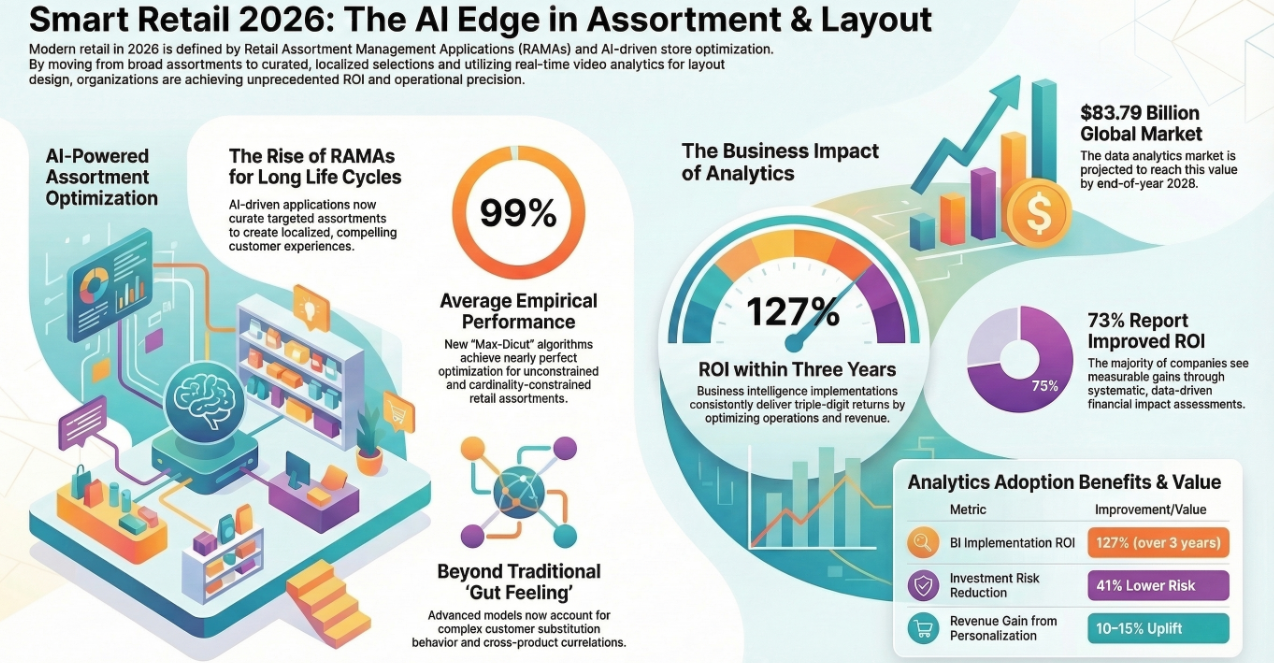
In the fast-moving retail landscape of 2026, simply knowing what your customers bought last month is no longer enough to stay competitive on the UK high street. While traditional business intelligence provided a useful "rearview mirror," the most successful UK SMEs are now moving toward a proactive posture that anticipates market shifts before they manifest. This journey represents a fundamental shift in how organisations handle information: moving from descriptive reports to prescriptive decision intelligence.
The Spectrum of Intelligence: From Hindsight to Prescriptive Action
To truly leverage modern data, SMEs must view their progress through an Analytics Maturity Model. Most businesses are comfortable with descriptive analytics (what happened) and diagnostic analytics (why it happened). Many have recently adopted predictive analytics, which uses machine learning to ask, "What is likely to happen?". However, the "crown jewel" of this evolution is prescriptive analytics. While predictive models might identify an upcoming surge in demand, prescriptive analytics takes the critical extra step of recommending the specific, optimal course of action to achieve a defined business objective. It moves the conversation from "What will happen?" to "What should we do about it?".
Hyper-Local Demand: The SME Advantage
For UK SMEs, the ability to compete with global giants lies in mastering the local market. Localised demand forecasting is the process of predicting consumer needs at a granular level, specifically tailored to the geographic and social characteristics of individual store locations or regional clusters. Consumer preferences in the UK are rarely uniform; an urban boutique in Manchester will face different shopping missions than a suburban shop in the Cotswolds. Successful prescriptive models now integrate hyper-local variables, including:
Revolutionising Assortment Planning
In the context of assortment planning, prescriptive analytics transforms how SMEs decide which products earn their place on the shelf. It is no longer about stocking a generic range, but about selecting the optimal mix of styles, price points, and categories to meet local demand while maximising profitability. By leveraging mathematical optimisation and scenario analysis, prescriptive systems can recommend the exact SKU count and replenishment schedule that minimises profit-eroding markdowns and costly stockouts. For example, a model might prescribe a 15% discount at three specific locations to clear slow-moving inventory before a seasonal shift, ensuring the remaining margin is protected.
The Algorithmic Engine: Making Machine Learning Accessible
Transitioning to these capabilities does not require an army of data scientists. Modern machine learning algorithms, such as Random Forest and XGBoost, are now being integrated into user-friendly platforms that allow SME leaders to simulate "what-if" scenarios. These models can account for complex substitution behaviours; the science of what a customer will buy if their first choice is unavailable. Using Advanced Choice Models, businesses can estimate the demand for new items that have no prior sales history by analysing their specific attributes, such as brand, size, or quality level. Furthermore, the Generative AI revolution is making these insights accessible through natural language. Instead of digging through complex spreadsheets, a store manager can simply ask, "Which products should I mark down this week to reach my profit target?".
Building a Culture of Quality
You cannot scale intelligence on top of chaos. Effective prescriptive analytics requires a "culture of quality," where automated data validation ensures that insights are not built on the "garbage in, garbage out" trap. For UK SMEs, this means unifying data from point-of-sale (POS) systems, loyalty programmes, and external signals into a single, trusted source of truth. The time to stop steering your business solely by looking in the rearview mirror is now. By unifying your reporting with algorithmic foresight, you empower every decision-maker to operate with the future in mind, turning local data into a true engine of strategic growth.
Paragraph7
Sources include:
Assortment Optimization Over Time, Cornell University
Constrained Assortment Optimisation, Institute for Operations Research and Management Sciences
Algorithm and Demand Estimation Procedure for Retail Assortment Optimisation, University of Pennsylvannia