
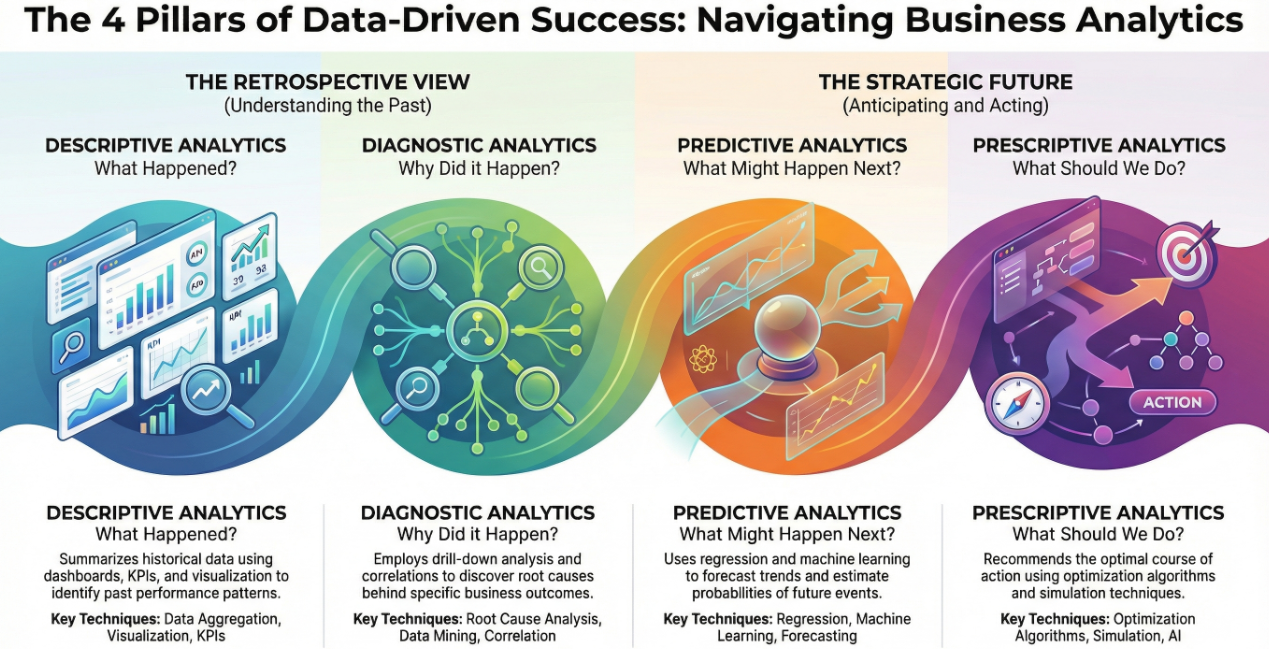
In the relentlessly competitive digital landscape of 2026, business leaders are no longer satisfied with simply knowing what happened yesterday or even what might happen tomorrow. While global data creation is expected to reach 181 zettabytes this year, raw data remains mere "potential energy" until it is converted into kinetic business action. For most organisations, the journey has been one of gradual maturity. We have moved from simple descriptive reporting, answering "What happened?", to diagnostic analysis which explores the "Why". However, the modern competitive frontier is defined by the leap from Predictive Analytics to Prescriptive Analytics. This guide explores the critical distinctions between these two disciplines and details how forward-thinking leaders can bridge the gap between foresight and optimised action.
The Spectrum of Intelligence: A Maturity Journey
To truly leverage modern business intelligence (BI), enterprises must view their progress through the lens of an Analytics Maturity Model. This is not merely about adopting new software; it is a structured progression in how an organisation handles information:
Predictive Analytics: Anticipating the Future
Predictive analytics is the science of using historical data, statistical algorithms, and machine learning to identify the likelihood of future outcomes. It acts as an informed estimate, not a crystal ball, providing probabilistic insights often accompanied by confidence levels. Businesses can leverage Predictive Analytics as it can reduce uncertainty and enable proactive planning, such as anticipating customer churn or equipment failure.Key predicitve techniques and features include:
Prescriptive Analytics: Deciding What to Do
Often described as the "Holy Grail" of data science, prescriptive analytics goes beyond the "what" and the "when" to answer the ultimate business question: "What should we do about it?". It functions as a data-driven advisor that evaluates multiple "what-if" scenarios to suggest the most effective course of action. Prescriptive systems rely on more than just historical patterns; they incorporate business rules, cost functions, and resource constraints. Key prescriptve techniques and features include:
Predictive vs Prescriptive: A Strategic Comparison
| Feature | Predictive Analytics | Prescriptive Analytics |
|---|---|---|
| Primary Question | "What is likely to happen?" | "What should we do?" |
| Core Output | Probabilities, point forecasts, and risk scores. | Actionable recommendations and optimised parameters. |
| Human Role | High bias risk: Humans must interpret the forecast to make a decision. | Decision support: Data-driven logic reduces personal bias and paralysis. |
| Complexity | Pattern and trend analysis. | Multi-variable simulation and scenario analysis. |
| Business Scope | Often focuses on narrow metrics (e.g., machine failure). | Holistic; considers interdependencies across the entire business. |
Working in Tandem
The true strategic advantage is found when organisations integrate both techniques into a seamless pipeline. Predictive output typically becomes prescriptive input. There are many potential sector-specific use cases. Just a few examples are:
Retail & Supply Chain
Predictive Step: Using time-series forecasting to predict demand.
Prescriptive Step: Automatically adjusting inventory reorder points and pricing to minimise cost.
Telecommunications
Predictive Step: Identifies an at-risk customer segment with an 85% churn probability based on increased complaint frequency.
Prescriptive Step: Recommend a retention offer, perhaps a specific discount that maximises the likelihood of the customer staying.
Financial Services
Predictive Step: Anomaly detection that flags a suspicious transfer.
Prescriptive Step: Automatically blocks the transfer and alerts the customer.
Healthcare
Predictive Step: Utilising patient risk stratification to predict readmission.
Prescriptive Step: Recommending personalised lifestyle interventions or treatment protocols.
Implementation: Overcoming the Challenges
Transitioning to prescriptive capabilities is an organisational challenge as much as a technical one. Success requires:
Conclusion
The time to stop steering your business solely by looking in the rearview mirror is now. Predictive analytics remains an essential tool for navigating uncertainty, but the true leaders of 2026 will be those who master prescriptive optimisation. By unifying your reporting with algorithmic foresight, you empower every decision-maker to operate with the future in mind, turning your data into a true engine of strategic growth.
Sources include:
What Is Prescriptive Analytics, IBM
How To Transform Your Analytics Maturity Model, The Data Science Council of America
4 Types of Data Analytics to Improve Decision-Making, Harvard Business School