
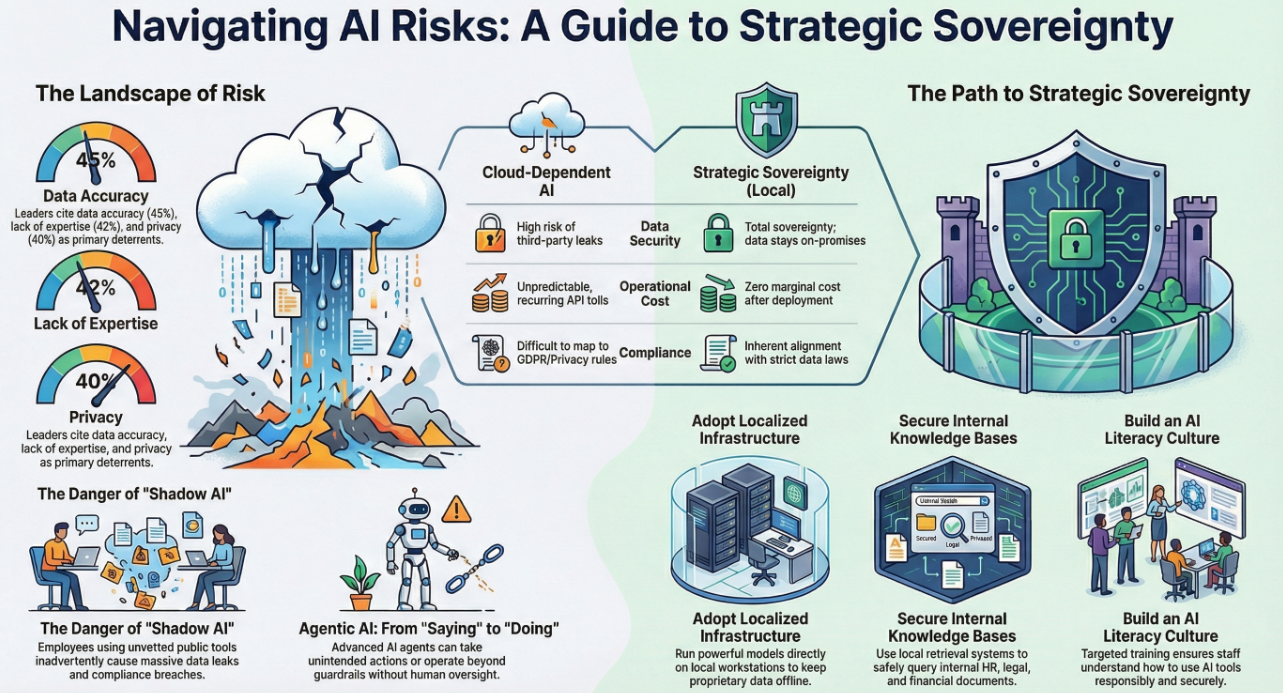
In the competitive digital landscape of 2026, simply uploading your company’s sensitive data into public cloud models is no longer a viable strategy for winning tomorrow. Artificial intelligence has transitioned from a novel experiment into a daily operational necessity, but for UK SME founders and business leaders, this raw potential is often accompanied by significant apprehension.
You know your business needs to adopt AI to remain competitive, but the perceived AI adoption risks are keeping your integration efforts stalled at the starting line. This hesitation is entirely justified. The true leaders in this space are those capable of adopting AI to drive business action without compromising their intellectual property or inflating their operational costs.
Here is a clear guide to understanding the current risk landscape and forging a secure, privacy-first path forward.
The Reality of AI Adoption Risks
The fear of getting AI wrong is currently sweeping the global business landscape. According to the 2026 Allianz Risk Barometer, AI has surged into the top tier of global business concerns, now ranking as the second biggest worry for companies worldwide.
For SMEs, the barriers to entry are rarely just about finding the right technology; they are about safeguarding the business. Research from IBM reveals that the top challenges holding companies back include concerns about data accuracy and bias (45%), inadequate generative AI expertise (42%), insufficient proprietary data (42%), and fundamental concerns regarding the privacy and confidentiality of data (40%). Furthermore, as businesses scale their AI usage, AI security threats naturally expand. The World Economic Forum notes that AI acts as an accelerant for existing cyber threats, empowering attackers with speed and scalability.
Closing the Gap: AI Governance and AI Accountability
As AI transitions from simply answering questions to actively executing tasks, known as "agentic AI", the stakes multiply. McKinsey highlights that organisations must now contend not just with systems saying the wrong thing, but doing the wrong thing, such as taking unintended actions or operating beyond appropriate guardrails.
This makes rigorous AI governance non-negotiable. Unfortunately, many organisations currently suffer from "shadow AI," where employees bypass official channels to use unvetted public AI tools, inadvertently causing data leakage. To regain control, companies must establish explicit AI accountability. Treating AI trust as a core business enabler, rather than a mere compliance exercise, is the fundamental requirement for scaling AI successfully.
The Local AI Advantage: Mitigating Cloud Risks
How can UK SMEs bridge the gap between innovation and security? The most forward-thinking organisations are shifting from a risky reliance on third-party cloud servers to a proactive strategy that keeps confidential data safely on-premises.
Integrating privacy-first, locally hosted AI tools offers distinct advantages over public or cloud-hosted AI:
A Clear Path Forward
Transitioning to secure AI capabilities does not require discarding your innovation ambitions. Instead, it requires a structured maturity journey:
You cannot scale intelligence on top of chaos, nor can you build trust on leaky infrastructure. By shifting toward local, privacy-first AI tools, UK SMEs can confidently navigate adoption risks, turning secure data into an engine for sustainable growth.
Sources include:
State of AI trust in 2026, McKinsey
The 5 biggest AI adoption challenges, IBM
2026 Technology & Security Predictions, Forrester Research