
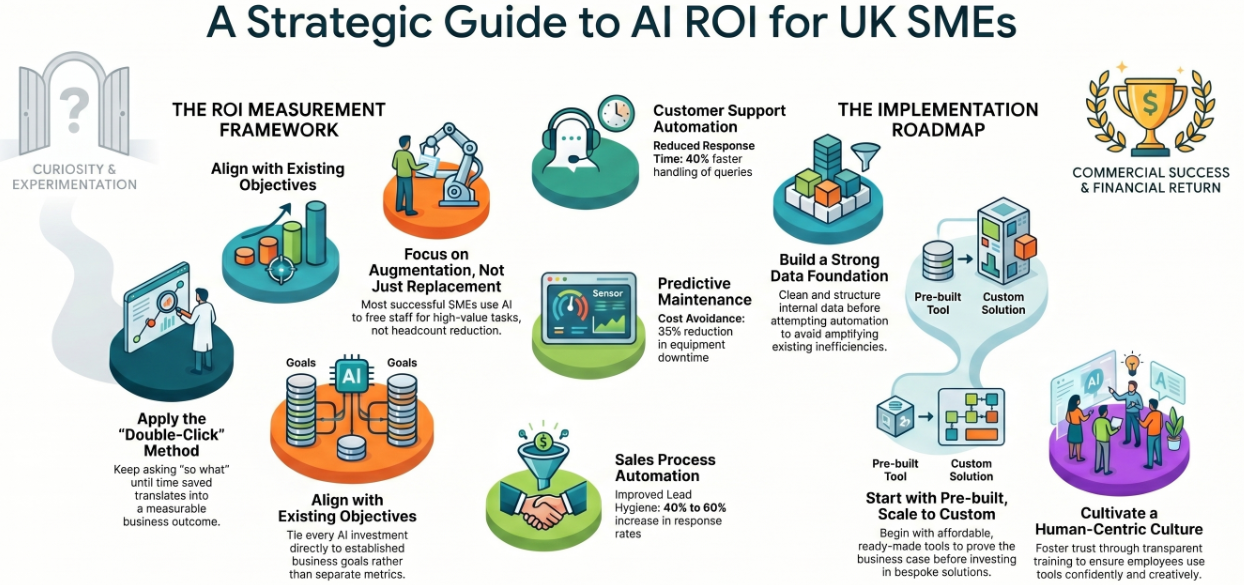
Research shows 54% of UK firms are paying for some form of AI. The harder part is figuring out if it actually pays them back. Between the software costs and the lack of internal expertise, committing to new digital tools feels risky. TechUK recently noted that a quarter of UK businesses are holding back specifically because they cannot map out the ROI. Getting past that means ignoring the hype and focusing strictly on the math.
Reality of AI in UK SMEs: Moving past the hype
Most SMEs currently use AI to draft emails, summarize meeting notes, or handle light admin. It saves a few minutes here and there, but it rarely changes the bottom line. The British Chambers of Commerce recently found that 95% of SMEs using AI have seen zero impact on their workforce size. Right now, it is an administrative convenience. Generating real financial returns requires treating the technology as an operational overhaul instead of just another software subscription.
A Framework for AI ROI optimisation
You have to measure the right things. Tracking "time saved" is a common trap. If a tool saves an employee five hours a week, but that employee spends the extra time browsing the internet, the business has not gained a single pound. Instead of tracking hours, track the business outcome. If a chatbot cuts customer service response times from 12 minutes to 4, the benefit isn't the eight saved minutes. The benefit is that your current team can handle 60% more queries, meaning you no longer need to hire three new reps to handle seasonal volume. You also need to judge these tools against your existing goals. If your primary objective this quarter is to shorten the sales cycle, you should only measure whether the AI software actually speeds up that specific timeline.
Advocating for a human-centric approach
You can buy the best software on the market, but it is useless if your team refuses to log in. Recent surveys show 36% of workers hide their AI use to keep a secret edge over their colleagues. Another 30% stay quiet because they assume the technology is being tested to eventually replace them. MIT research points out that only 5% of integrated AI pilots actually deliver significant value. That is a management failure, not a software glitch. Successful rollouts usually start small. Management tests a specific workflow, measures the result, and scales it only if it works. Once employees realize the software is there to handle the tedious parts of their day rather than take their jobs, adoption happens naturally.
Building Your AI Adoption Strategy
You do not need a massive budget to get this right. Roughly 44% of UK SMEs start with standard, off-the-shelf platforms. They are relatively cheap and you can deploy them in an afternoon. You can worry about building a custom, proprietary system later if the baseline tools actually prove their worth. Before you buy anything, fix your data. AI cannot organize a mess. If your customer records and inventory data are scattered across outdated systems, the new tools will simply generate faster errors. Clean up the core systems first. Address the very real anxieties of your staff, run small tests, and refuse to pay for any tool that doesn't tie directly back to a measurable business goal.
Sources include:
Half of SMEs Using AI - With Limited Headcount Impact So Far, Bristish Chambers of Commerce
State of AI in Business, Massachusetts Institute of Technology
Major barriers to AI adoption, UK's Technology Trade Association