
Overcoming the Perceived Risk of Legacy Technology Infrastructure in AI Adoption

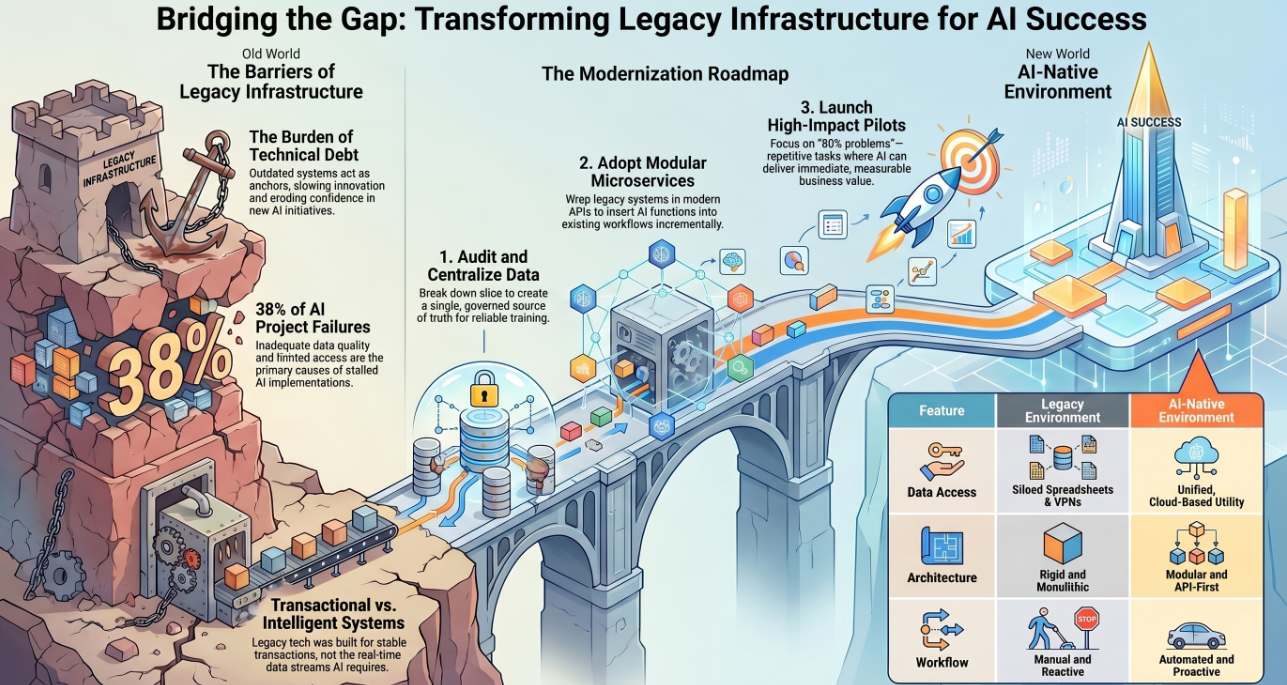
 LegacyTechnologyInfrastructureInAiAdoption Infographic

Fifth post in our 'AI Adoption' Blog Series.
April 2026

Every business leader today should recognise that AI adoption is no longer a futuristic luxury but a core necessity for maintaining a competitive edge. However, many UK SME founders face a daunting reality: their daily operations still run on legacy technology. If your business relies on siloed Excel spreadsheets, ageing on-premise databases, and disconnected software, embarking on an enterprise AI strategy can feel like building a skyscraper on a foundation of sand. This hesitation is understandable as it is completely normal to feel concerned that your current IT infrastructure isn't "ready" for advanced artificial intelligence. What is needed is an AI development strategy that bridges the gap between your legacy systems and an AI-powered future.

The Burden of Technical Debt in Business AI Adoption
When planning an AI adoption strategy, technical debt is often the heaviest anchor. Research from Cisco notes that unmanaged technical debt, such as outdated systems and fragile integrations, can slow innovation, delay ROI, increase costs, and erode confidence. Legacy systems were traditionally built for transactional stability, not for the dynamic, real-time data streams required by modern artificial intelligence. Consequently, these rigid, isolated platforms create severe barriers to AI adoption. They trap vital information in data silos, making it nearly impossible to achieve the unified view that intelligent algorithms require to function accurately.

Why Data is the Ultimate Stumbling Block
The fears SMEs have surrounding legacy systems are entirely justified. A recent Gartner survey of 782 Infrastructure and Operations (I&O) managers paints a revealing picture of modern AI adoption challenges. According to the research, 57% of those interviewed admitted to at least one failed attempt to implement AI within their domain. Crucially, 38% of these managers cited poor data quality and limited data access as the primary stumbling blocks leading to project failure. Managers assumed AI would immediately fix long-standing operational issues, but without the right foundation, confidence drops and projects stall. Quite simply, you cannot build reliable AI on unreliable, inaccessible data.

Furthermore, a recent IBM report highlights that 45% of organisations are deeply concerned about data accuracy or bias, while 42% feel they lack sufficient proprietary data to customise their models effectively. When your business data is scattered across legacy systems and spreadsheets, AI models cannot provide reliable, actionable insights. This fragmentation is a universal hurdle that severely impedes AI readiness.

A Clear Path Forward: AI Strategy Development Roadmap
Having legacy infrastructure is not a permanent roadblock; it is simply your starting point. Transforming your business does not require ripping out all your old systems overnight. Instead, a successful AI strategy for business relies on smart, incremental modernization. Here is a practical approach for UK SMEs to navigate this transition:

  1. Audit and Centralise Your Data
    Before implementing any AI tools, conduct a holistic review of your current data landscape. You must understand where your data lives, how it is structured, and whether it can support AI reliably. Adopting platforms that help consolidate information into a single, governed environment enables you to break down silos. Standardising your data ensures that your AI models are trained on a single source of truth.

  2. Embrace Modular Solutions
    You do not need to discard your legacy systems entirely. By decoupling legacy systems into microservices wrapped with modern APIs, your organisation can create a more flexible foundation for AI integration. This allows you to insert AI-driven functions into existing workflows incrementally.

  3. Start Small with High-Impact Pilots
    The most successful AI adoption journeys begin with targeted, small-scale pilot projects rather than massive overhauls. Focus on opportunities where AI can deliver measurable business value, such as automating routine reporting, enhancing customer service, or streamlining supply chain logistics. Research from MIT Sloan emphasizes that modernising legacy architecture with small, cross-functional teams and modular components enables faster, more scalable AI delivery. Pilot projects allow you to test technical feasibility in a controlled environment and build organisational confidence before scaling wider.

Conclusion
The perceived risk of legacy infrastructure should not deter your business AI adoption. While ageing databases and siloed spreadsheets present genuine AI adoption challenges, they can be methodically overcome through a structured strategy. By auditing your data, leveraging modular cloud technologies, and starting with focused pilot projects, your SME can modernise its operations safely and effectively. By confronting your legacy technical debt today, you are paving the way for a more resilient, intelligent, and competitive business tomorrow.

Sources include:
AI Adoption Challenges, IBM
Emerging Tech Impact Radar: Generative AI, Gartner
Boost your organization’s AI maturity level, MIT Sloan
AI Adoption Research, Department for Science, Innovation and Technology GOV.UK