
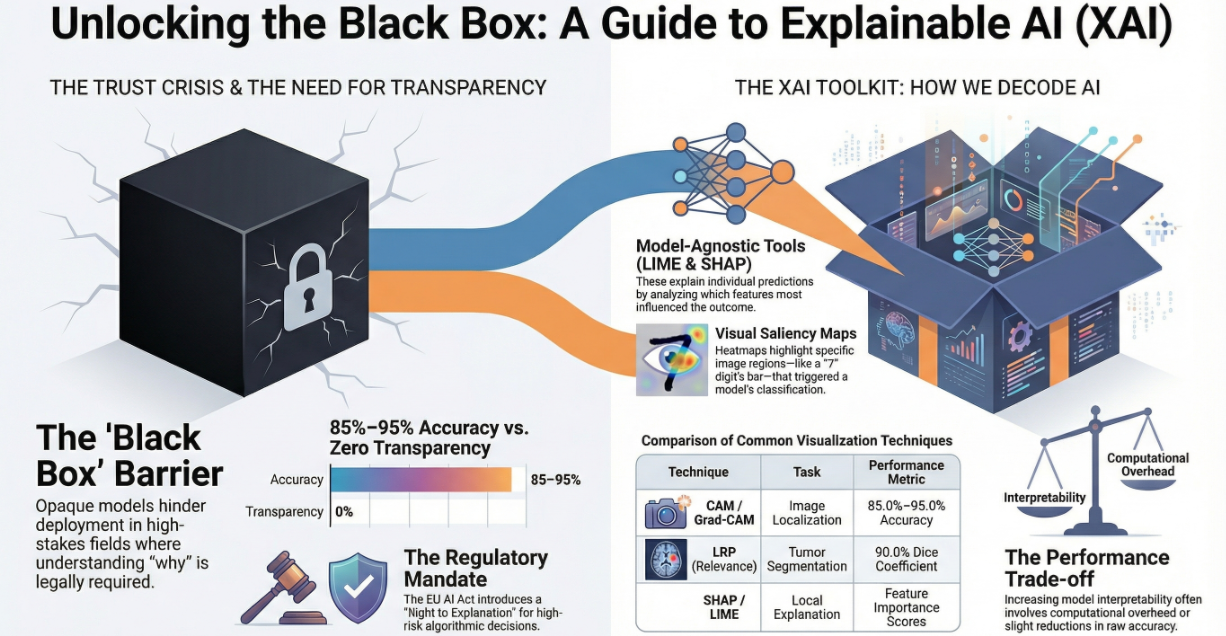
We are increasingly letting AI models make decisions about medical diagnoses and credit approvals. The problem is that we don't actually know how most of them work. High-dimensional models are black boxes. They are so complex that even the engineers who built them can't tell you exactly why a specific conclusion was reached. For industries like healthcare and finance, where accountability is mandatory, you can't just shrug and blame the algorithm.
Distinguishing interpretability from explainability
People often mix up interpretability and explainability, but the distinction matters. Interpretability means the model is transparent by design. A human can look at the math and understand how it works. Explainability (or XAI) is what happens when you are forced to use a black box. It involves tacking auxiliary tools onto a trained model to try and guess why it made a specific decision.
The shifting regulatory landscape
Figuring out how AI makes decisions isn't just an academic exercise anymore; it's a legal requirement. The EU's GDPR includes a right to explanation for automated decisions. Now, the EU AI Act requires high-risk systems to be fully traceable. If you deploy one of these models, you need to know exactly what it can do and where it fails.
Methods for unlocking the box
Researchers have a few ways to peek inside these opaque systems. The easiest route is using inherently interpretable models like decision trees, where the logic is obvious from the start. When that isn't possible, they use post-hoc tools like LIME or SHAP. These approximate a complex model's local behavior to figure out which variables drove a specific outcome. Another approach is counterfactual explanations, which tell you what needed to change to get a different result. If a system rejects your loan, a counterfactual might reveal that an extra £5,000 in annual income would have changed the decision. Finally, for image-based models, tools like Saliency Maps generate heatmaps to show exactly which pixels the model looked at.
The power of "human-in-the-hoop" (HITL)
Most real-world systems work best when they pair machine scale with human judgment. This is called a Human-in-the-Loop framework. Financial risk tests show that adding human oversight increases fraud detection accuracy by 15 percent and cuts down the time compliance officers spend reviewing cases. When domain experts can actually review and override the algorithm's reason codes, they are far more willing to trust the system.
Ethical considerations and the "glass box" movement
We need explainable AI to catch algorithmic bias. If a system has to explain its reasoning, developers can see when it is cheating. A classic example is a medical classifier that learns to spot the physical ruler in a dermatology photo instead of analyzing the skin lesion itself. Many researchers now argue for "glass box" models for high-stakes areas like criminal justice. The rule of thumb is straightforward: if a simple, transparent model matches the accuracy of a black box, use the transparent one.
The generative AI challenge
Large Language Models like GPT and Claude make all of this much harder. Standard explainability tools struggle with massive, recursive architectures. Because of this, researchers are pivoting to mechanistic interpretability. They are trying to reverse-engineer these massive models neuron by neuron just to understand what they are actually doing.
Sources include:
Intrinsically Interpretable explainable AI, XAI World Conference
Is Attention Interpretable in Transformer-Based Large Language Models?, Hugging Face
Humans in the Loop: The Design of Interactive AI Systems, Stanford HAI