
We are moving past the era where AI just guesses the next word. Today's models verify their own logic, process video in real time, and run on local hardware. The technology is shifting from a parlor trick to a functional piece of enterprise infrastructure.
Beyond scaling: the push for reasoning
For years, the industry relied on the scaling hypothesis. The assumption was that throwing more data and compute at a model would automatically make it smarter. That focus is now shifting toward reasoning capability. Models like DeepSeek-R1 and OpenAI o1 use reinforcement learning to generate a chain of thought. They test different logical paths and catch their own mistakes before returning an answer. This matters for math and law, where a correct answer is useless if the system cannot prove how it got there.
Breaking the quadratic wall
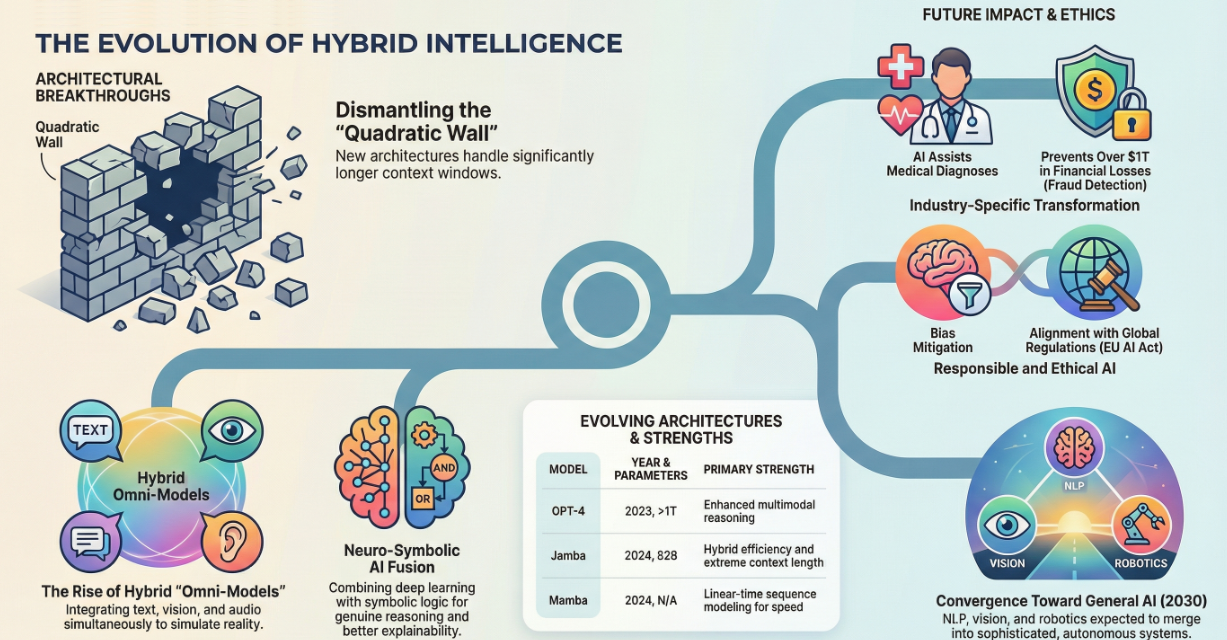
Transformers have dominated the space since 2017. Their main flaw is the quadratic wall, meaning computational cost grows quadratically as the input gets longer. If you want a model to read an entire book, the compute costs become unmanageable. State Space Models like Mamba scale linearly, handling massive context windows cheaply. Newer hybrid architectures like Jamba mix Transformer layers with Mamba and Mixture-of-Experts modules. You get the reasoning of a Transformer but the memory efficiency of a State Space Model, fitting hundreds of pages of text on standard consumer hardware.
Running models locally
Running these models locally is finally becoming practical. Microsoft's 1-bit LLM project restricts model weights to -1, 0, or 1. This cuts memory use by 90 percent and turns expensive multiplication operations into basic addition. On the training side, the Muon optimizer matches the standard AdamW optimizer's quality but uses half the compute. Teams no longer need a massive data center to train or run useful models.
Multimodal models and physics engines
Text is no longer the only input. Omnimodels process text, audio, and video simultaneously in the same context. A business can feed screen recordings and voice calls into a model to catch errors as they happen. Research labs are also building world models. Instead of just analyzing text, these systems build internal physics engines to understand mass, gravity, and spatial relations. If a model understands how the physical world works, it is much less likely to invent impossible scenarios.
From basic search to autonomous agents
The industry is moving from basic search functions to autonomous agents. Instead of just retrieving a PDF, these systems plan a research strategy. They cross check claims and evaluate their own findings before returning an answer. This leaves a clear audit trail, giving companies the transparency they need to comply with the EU AI Act rolling out this year.
Untangling safety and truth
Making models more accurate sometimes makes them less safe. Researchers found that the internal mechanisms handling factual truthfulness often overlap with the ones handling safety refusals. If developers turn up the truthfulness, they accidentally bypass the guardrails. Teams are now using Sparse Autoencoders to pull these features apart, allowing them to fix factual errors without breaking the safety filters.
What happens next
Language models, computer vision, and robotics are merging into unified systems. The organizations getting actual value out of this shift are moving past basic text generation. They are using these systems to simulate outcomes and solve concrete business problems without running afoul of new regulations.
Sources include:
The Future of Human-AI Communication and Language Models, Journal of Scientific and Engineering Research
Advances to Low-bit Quantization Enable LLMs on Edge Devices, Microsoft Research
What is Agentic RAG?, IBM