
UK SME founders are in a tough spot this year. You know you need to adopt AI to stay competitive, but you are also staring down the barrel of the UK's 2050 net-zero targets. The environmental cost of this technology is staggering. It takes vast amounts of electricity to train language models and billions of litres of water to cool the data centres that host them. But you do not have to choose between upgrading your tech and hitting your emissions targets. If you understand what makes AI so hungry for resources, you can find leaner ways to run it.
Understanding the footprint and why AI is resource-intensive
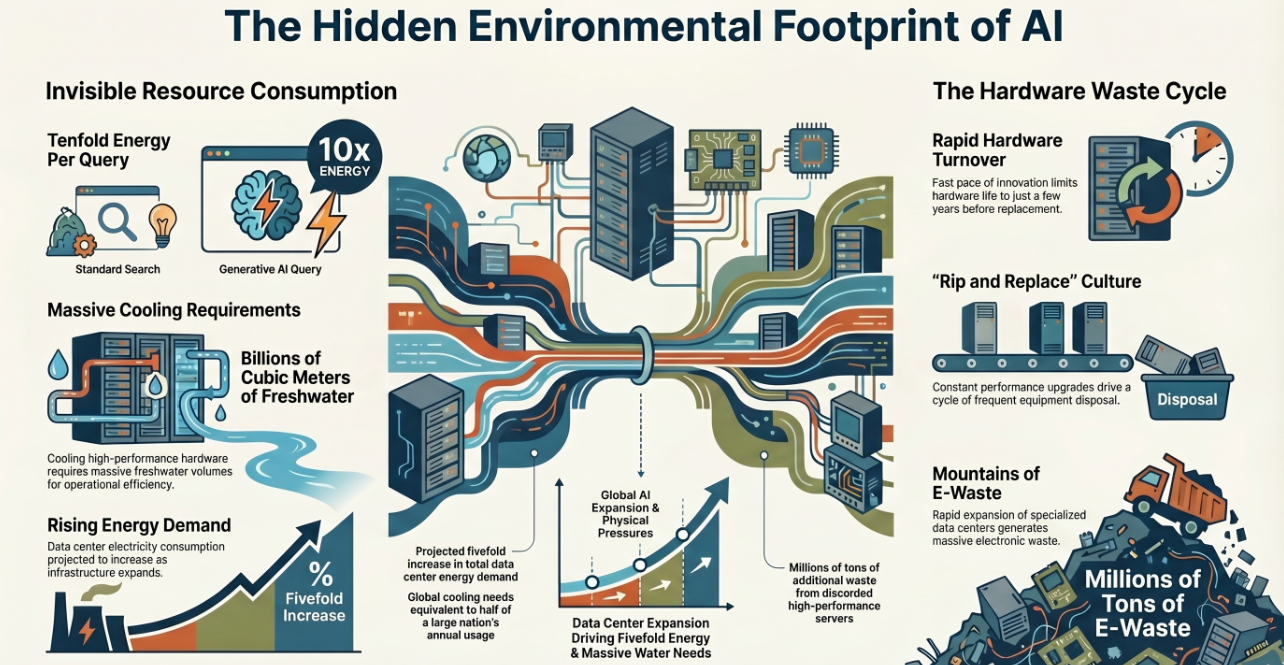
Before you start hooking AI into your daily operations, it helps to know exactly what you are paying for in carbon and water. AI burns significantly more power than standard cloud computing. A single generative AI query can draw ten times more energy than a simple web search. UK data centres currently draw about 2% of the national grid, but that number is expected to hit 26 TWh by 2030. Then there is the water. Keeping high-performance hardware from melting down requires massive cooling systems. Training GPT-3 alone took about 700,000 litres of water. By 2027, global AI water demand could hit 4.2 billion cubic metres. That is half of the UK's total annual water usage. Finally, there is the hardware itself. The technology moves so fast that high-performance GPUs and servers are often obsolete in two to five years. This constant replacement cycle could add 5 million tonnes of e-waste globally by 2030.
A path forward and how SMEs can minimise harm
You can still adopt these tools without throwing your sustainability pledges out the window. Start by looking for models trained on sustainable infrastructure. Some developers are already building models with a 90% lower carbon footprint than the standard industry options. You can also rethink your hardware cycle. Buy refurbished equipment or maintain your current servers to extend their life, rather than ripping and replacing everything every three years. Better yet, use AI to fix the emissions problems you already have. A lean model that optimises your supply chain or runs your building's energy management system can end up saving more carbon than it costs to run.
The role of local AI in reducing environmental harms
For a lot of UK businesses, the most practical answer is Local AI. This means running models on your own servers instead of renting time from a massive, distant cloud provider. Keeping things local cuts out the constant data movement, compression, and encryption between your office and a remote data centre. You avoid the computational overhead required just to shuffle data back and forth. You also have total control over the power source, meaning you can guarantee the hardware runs on green energy.
Instead of calling a massive, general-purpose model to do a simple job, local setups let you run smaller, efficient models built for specific tasks. This takes far less power and cooling. It also takes pressure off the national grid, especially for applications that need real-time processing without the lag of a cloud connection.
The bottom line
The government wants the UK to be an AI superpower, and that push gives SMEs a chance to grow. But the physical reality of the technology is impossible to ignore. It eats electricity, water, and silicon at an incredible rate. If you start with a clear sustainability plan and rely on smaller, local models where possible, you can modernise your business without setting your carbon targets back by a decade.
Sources include:
AI for decarbonisation, The Alan Turing Institute
Implications of algorithms, data, and artificial intelligence, The Nuffield Foundation
Semiconductor sustainability: New life through circularity, Deloitte US