
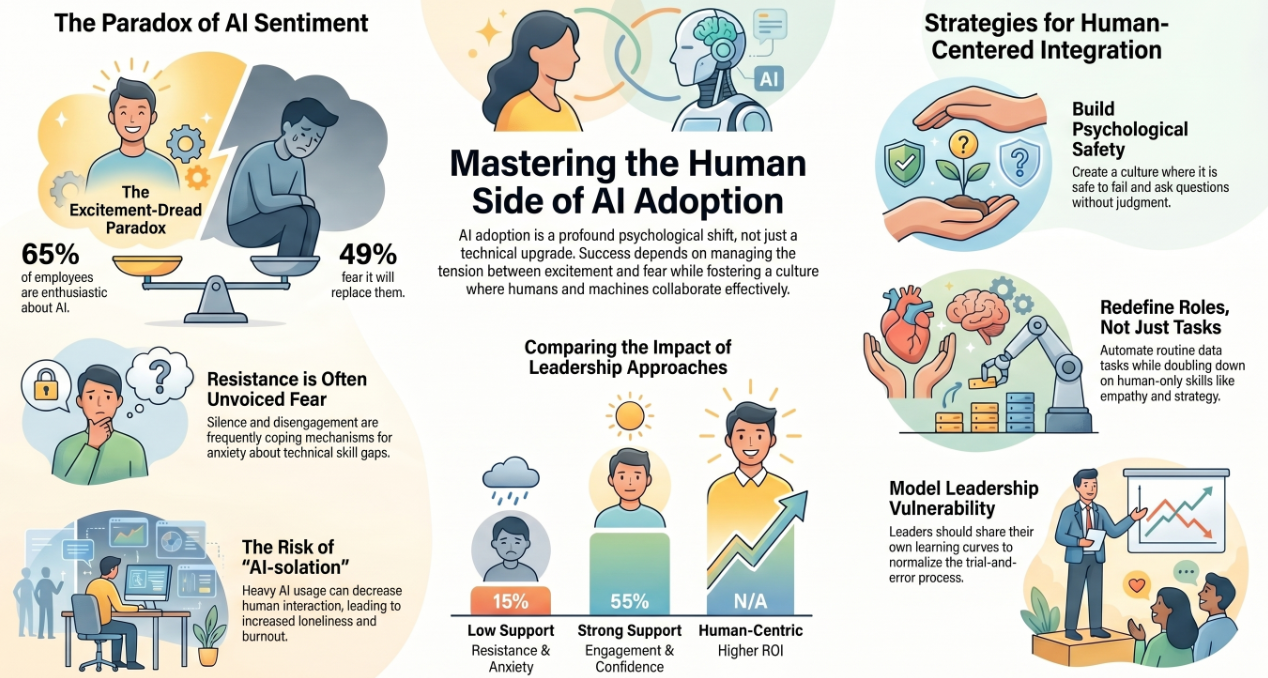
Most business leaders know they need AI. The budget gets approved, the software gets deployed, and then nothing happens. The team just doesn't want to use it. Moving to an AI-powered workplace is a massive psychological shift, not just an IT upgrade. If you see hesitation or friction from your staff, you aren't alone. Getting a company to actually use AI means managing the humans, not the algorithms.
The SME reality: rising trust meets rising anxiety
Over the last year, UK business owners have grown to trust AI. Their employees, meanwhile, have grown terrified of it. They know they lack the technical skills, and they are right to worry. PwC data shows the skills needed for AI-exposed jobs are changing 66% faster than for standard roles. Founders look at an AI roadmap and see efficiency. Employees look at it and see a brutal learning curve. They worry they will be left behind if they don't learn fast enough, but asking for help feels like admitting incompetence. The result is a quiet panic that stalls the whole project.
Decoding employee AI sentiment and concerns
The current office mood is complicated. A recent survey found that 65% of employees are excited to use AI, but half of that exact same group worry the tools will eventually replace them. If you ignore this contradiction, your team will disengage. You also have to watch out for isolation. When people ask a chatbot for answers instead of tapping a colleague on the shoulder, they stop talking to each other. Research shows the heaviest AI users at work report higher loneliness, which eventually leads to burnout and poor sleep.
Empowering the workforce through employee AI learning
A one-hour training seminar won't work for software that changes every week. Companies need to let people learn while doing their actual jobs. MIT Sloan researchers suggest looking at your data to find specific skills gaps, then offering targeted, hands-on practice. Unilever did this well. They built "Unabot", an internal assistant that helps new hires find company policies. Staff gave it an 80% usefulness rating. It worked because the company framed the AI as a helpful coworker rather than a top-down corporate mandate.
Actionable steps for SME leaders
Give your team a sandbox. Let them break things and ask questions without tying their experiments to performance reviews. You can also pair people up. Put your tech-forward employees with the hesitant ones so learning stays social. Most importantly, tell people exactly what you want the AI to do. Explain that the tool is taking over the data entry so they can spend more time on strategy and client relationships.
Proven employee AI engagement strategies
Getting your team to collaborate with AI requires psychological safety. Harvard's Amy Edmondson proved years ago that teams only learn when they feel safe taking risks. If an employee thinks a bad prompt will ruin their career, they will just hide their screen. To fix this, leaders need to fail in public. When a founder admits they spent an hour fighting with an AI to get a simple summary, it gives the rest of the company permission to struggle. You also have to focus on the humans. Deloitte found that companies using AI to augment their staff, rather than to cut headcount, are 1.6 times more likely to beat their financial targets. Set up a dedicated feedback loop where people can point out when the AI is wrong. If the tool hallucinates, they need to feel safe calling it out without management accusing them of hating innovation.
The path forward
Buying an AI subscription is the easy part. The actual work is figuring out how your specific team is going to work alongside it. If you respect their anxiety and give them a safe place to learn, they will figure it out.
Sources include:
AI Jobs Barometer, PricewaterhouseCoopers
Psychological safety and learning behavior in work teams, Dr. A Edmondson, Harvard Business School
How Artificial Intelligence Is Transforming Jobs and Organizations, Gartner
2026 Global Human Capital Trends, Getting human and machine relationships right, Deloitte Insights