
DataOps Principles For Analytics Workflows
WaveTech AI Blog Posts
March 2026
In the modern digital economy, data is no longer just a byproduct of business; it is the primary engine of competitive advantage. Yet, for many UK organisations, the bridge between raw data and actionable insight remains fragile, manual, and frustratingly slow. As global data creation is increasing at a staggering rate, traditional "bespoke" methods of managing analytics are failing to keep pace. Past surveys of major analytics projects found that 80 percent of companies’ time is spent on tasks such as preparing data. To solve this, forward-thinking leaders are turning to DataOps, a methodology that applies the rigor of software engineering to the world of data. By automating workflows and fostering collaboration, DataOps allows companies to convert data from "potential energy" into "kinetic business action".
What is DataOps?
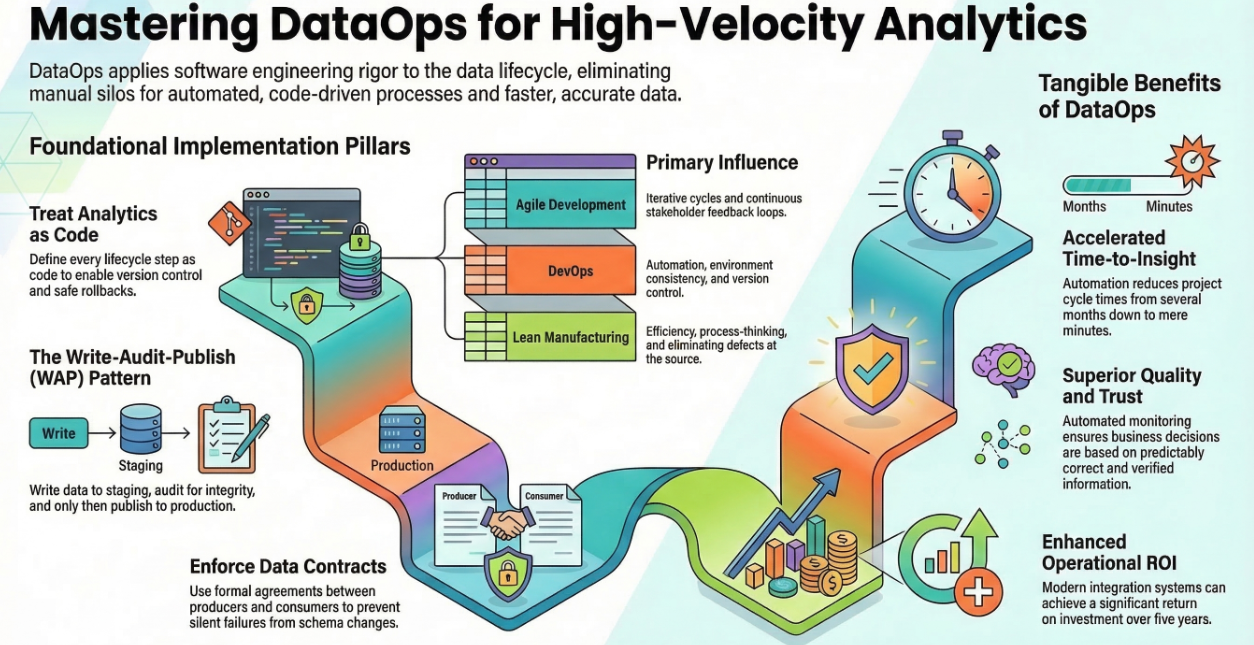
What is DataOps exactly? It is a collaborative data management strategy that combines the principles of Agile development, DevOps, and Lean manufacturing to streamline the entire data lifecycle. Its primary objective is to reduce "cycle time"; the duration between the start of an analytics project and the delivery of a finished, ready-for-use report or model. While it borrows heavily from software engineering, it is important to understand the nuance of DataOps vs DevOps. While DevOps focuses on the rapid release of code and software, DataOps manages the dynamic and often unpredictable nature of data itself, ensuring its quality, reliability, and governance across disparate systems.
The Tangible Benefits of a DataOps Strategy
Adopting DataOps best practices offers far more than just technical efficiency; it is a fundamental business strategy that delivers four core advantages:
- Accelerated Time-to-Insight: By implementing DataOps, organisations can automate manual processes, reducing cycle times from months to weeks or even minutes. Some enterprises have reported up to a 93% reduction in daily load times.
- Superior Data Quality and Trust: Automated testing and monitoring significantly reduce human error, ensuring that business decisions are based on "predictably correct" information.
- Enhanced Operational Efficiency and ROI: Automation eliminates redundant manual tasks, allowing data teams to focus on innovation rather than "firefighting". Modern integration systems have been shown to achieve a 33% return on investment over five years.
- Radical Collaboration: DataOps breaks down silos between data engineers, analysts, and business stakeholders, fostering a culture of shared responsibility and continuous improvement.
Core DataOps Best Practices for 2026
For UK SMEs looking to establish excellence, implementing DataOps requires a focus on these four foundational pillars:
- Treat Analytics as Code: Every step in your data lifecycle, from ingestion and transformation to visualization, should be defined as code. This allows your team to use version control enabling them to track every change, collaborate safely, and roll back if something goes wrong. Tools like dbt (Data Build Tool) can be used allowing definition of modular transformation layers (Staging, Intermediate, and Marts) to keep your logic auditable and reusable.
- Invest in Automation and "Slim" Builds: Manual data cleansing is a waste of valuable human resources. DataOps best practices dictate automating repetitive tasks like ingestion and testing. To maintain speed as your systems grow, adopt "Slim CI" (Continuous Integration). This pattern ensures that when a change is made, only the affected models and their downstream dependencies are rebuilt, saving significant compute costs and feedback time.
- Implement the Write-Audit-Publish (WAP) Pattern: To prevent "bad data" from ever reaching a production dashboard, the WAP pattern creates a safety net.
Write: Data is generated in an isolated staging environment.
Audit: Automated tests (checking for nulls, row counts, and schema drift) verify the data's integrity.
Publish: Only after successful validation is the data moved into the live production environment.
- Adopt Data Contracts: A common pain point is "silent breakages" caused by upstream schema changes. Data contracts are enforceable agreements between data producers and consumers . These contracts ensure that if an upstream system changes a column name or data type, the pipeline stops automatically, providing a clear signal before downstream reports are impacted.
The Business Case: Speed, Quality, and ROI
For businesses, DataOps is not merely a technical upgrade, it is a financial strategy. By shifting from a reactive "firefighting" posture to a proactive, automated one, organisations can see a significantly faster time to actionable insights. By starting small, perhaps with a single dataset and applying these best practices, your organisation can turn data into a true engine of strategic growth.
Sources include:
What is DataOps?, Hewlett Packard
How companies can use DataOps to jump-start advanced analytics, McKinsey
How Virgin Media O2 uses data contracts to enable trusted data and scalable AI products, Google