
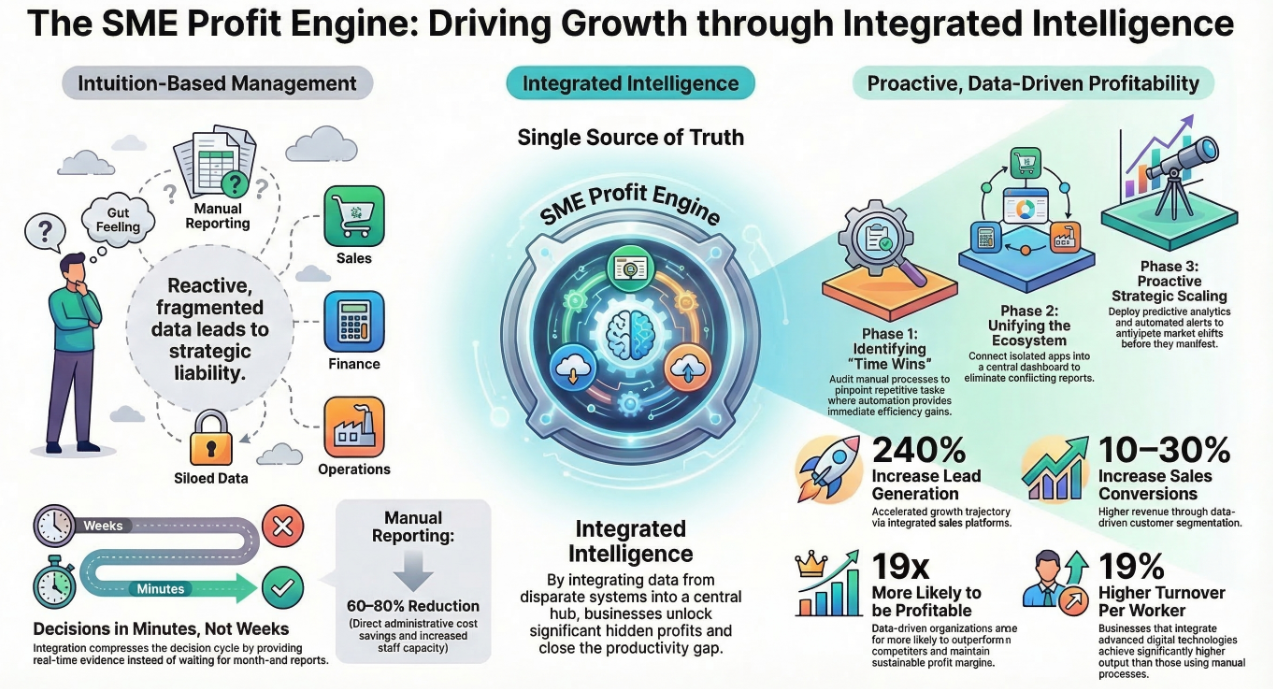
UK SMEs make up 99.9% of the business population. They are the economy. But with inflation still hovering and post-Brexit trade rules settled into a messy reality, running a business on spreadsheets and "gut feeling" is getting dangerous. Business Intelligence (BI) is no longer a corporate luxury. It is how you actually protect your profit margins.
Productivity and the Data Lever
The UK has a well-documented productivity problem. However, the 2025 data from the Office for National Statistics points to a clear way out. Businesses that use modern digital tools like BI software generate about 19% more turnover per worker. When your sector accounts for half of the UK's total turnover, a 19% bump is massive. The math is hard to argue with because companies that run on data are simply more profitable than those flying blind.
Shrinking the Decision Cycle to Minutes
The biggest immediate change when you install a BI system is how fast you can see what is actually happening. Traditional management usually means waiting for the month-end close to review performance weeks after the fact. Modern BI cuts that wait down to minutes. Instead of guessing, you know right away if lead conversions drop or material costs suddenly spike. You get the chance to fix a small issue before it ruins your quarterly numbers.
Where the Profits Actually Hide
BI software does more than generate pretty charts. It changes the bottom line in three specific ways:
Breaking the Spreadsheet Habit
The main thing stopping UK SMEs from using BI properly is data isolation. Nine out of ten companies have information stuck in separate apps that refuse to talk to each other. Spreadsheets break the second someone changes a formula. To fix this, you have to pull your point of sale, CRM, and accounting data into a single dashboard. When your entire team looks at the exact same numbers for inventory and cash flow, they make better decisions.
How to Adopt BI Without the Headaches
You do not have to overhaul your whole company overnight. The most successful rollouts start small and build up over a year. In the first month, audit your current manual processes. Find the most annoying and time-heavy reporting tasks and automate those first so you get an immediate return on your investment. Over the next couple of months, focus on connecting your isolated software tools by using a BI platform to pull everything into a single view. Once the basics are running smoothly, you can spend the rest of the year turning on the advanced features like automated alerts for low stock levels or predictive models to plan for the next quarter.
Building a Long-Term Moat
Going into 2027, BI is shifting from a nice bonus to a basic requirement. Soon, SMEs will compete on financial clarity just as heavily as they do on product quality. If you can show banks, investors, and potential hires real-time proof of your performance, you win. The market is too volatile to guess your way through. Running a business without clear data is just an unnecessary risk.
Sources include:
The turning point for SMEs: Unlocking the next level of AI, British Chambers of Commerce
AI ROI: The paradox of rising investment and elusive returns, Deloitte
UK Small Business Statistics, Federation of Small Businesses