
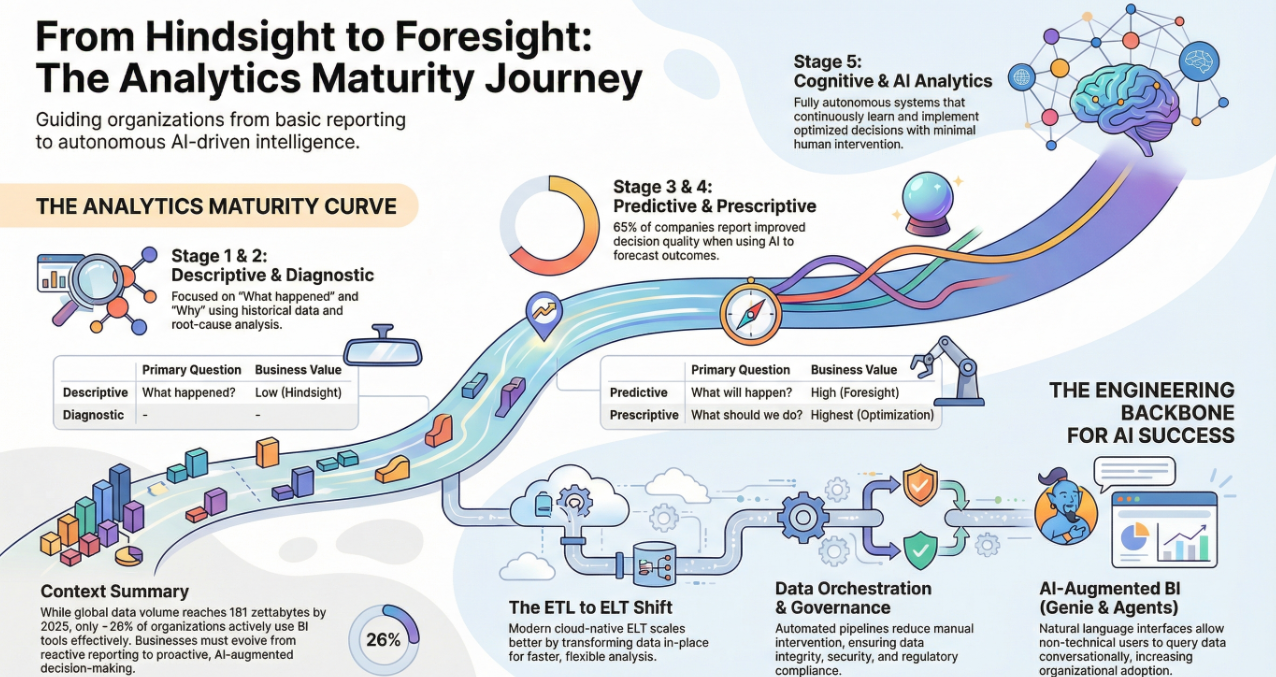
We generated 181 zettabytes of data globally this year. I cannot even visualize that number. It is roughly three times what we produced just five years ago. But hoarding data does not actually fix anything. If all you have is a dashboard telling you what broke yesterday, you are just admiring the problem. Traditional BI has always been a history lesson. It is great for knowing what went wrong. But the companies actually making money off their data are plugging in predictive analytics to figure out what happens next. They are moving from firefighting to fire prevention.
The analytics maturity model
You do not just buy a predictive AI tool and flip a switch. It is a slow progression in how a company handles information. Most teams start at descriptive analytics. They look at basic KPIs to see what happened. Then they move to diagnostic analytics to figure out why it happened. The breakthrough happens at predictive analytics, where you use machine learning to forecast the next quarter. Prescriptive analytics goes a step further by simulating different choices to tell you what to do about it. The final stage is cognitive AI, where the system just makes the operational decisions for you.
Building a predictive architecture
You do not have to throw away your current BI tools. You just have to fix the plumbing behind them. The first step is moving from ETL to ELT. We used to transform data before loading it. Now, cloud platforms like Snowflake or Databricks let you load the raw data first and transform it later. You want to keep the raw data intact because machine learning models need it for training. Next is the lakehouse architecture. Data warehouses are great for BI, and data lakes are great for AI. A lakehouse combines them so your data scientists and business analysts stop arguing over whose numbers are right. You also need a semantic layer. If an executive asks a conversational AI for the churn rate, the AI needs a strict corporate definition of "churn." Otherwise, it will invent its own math.
Putting models into reports
The hardest part of data science is getting regular people to actually use the models. A data scientist might build a brilliant random forest model to predict customer churn, but it usually sits in a notebook somewhere. Now, you can plug those models directly into everyday BI reports. A sales manager can drag a tenure slider on their screen and watch the churn probability update immediately. For heavier enterprise workloads, you can host the model on a web service and ping it via an API so the dashboard never slows down.
Talking to your data
The most obvious change right now is the death of the static dashboard. Natural language tools mean you can literally ask your database questions. You type, "Which region missed target last quarter and why?" and get an answer. It skips the hours of SQL querying and lets nontechnical leaders find their own answers.
Where this actually works
This looks different depending on the industry. Banks use anomaly detection to flag weird cross-border transfers immediately instead of waiting for a monthly audit. Retailers factor weather forecasts and competitor sales into their supply chain models, which can reduce stockouts by up to 30%. Telecom providers look for behavioral changes, like a sudden spike in support tickets, to offer discounts before a customer cancels. Hospitals calculate readmission risks to prioritize care for vulnerable patients.
Governance and the path forward
If your underlying data is garbage, your predictive models will just generate garbage faster. You need automated validation checks to catch bad inputs early. Privacy rules are also getting stricter, which is why federated learning is catching on. It lets you train models across different locations without ever moving the sensitive raw data to a central server. We collect too much data now to just use it for historical reporting. If you plug predictive models into your daily operations, you can finally stop reacting to yesterday's crises and start preparing for tomorrow's.
Sources include:
Harnessing Big Data for Predictive Analytics, New York Institute of Technology
Predictive Analytics for Telecom Customer Churn, Journal of Computer Science and Technology Studies
What is Data Governance?, IBM