
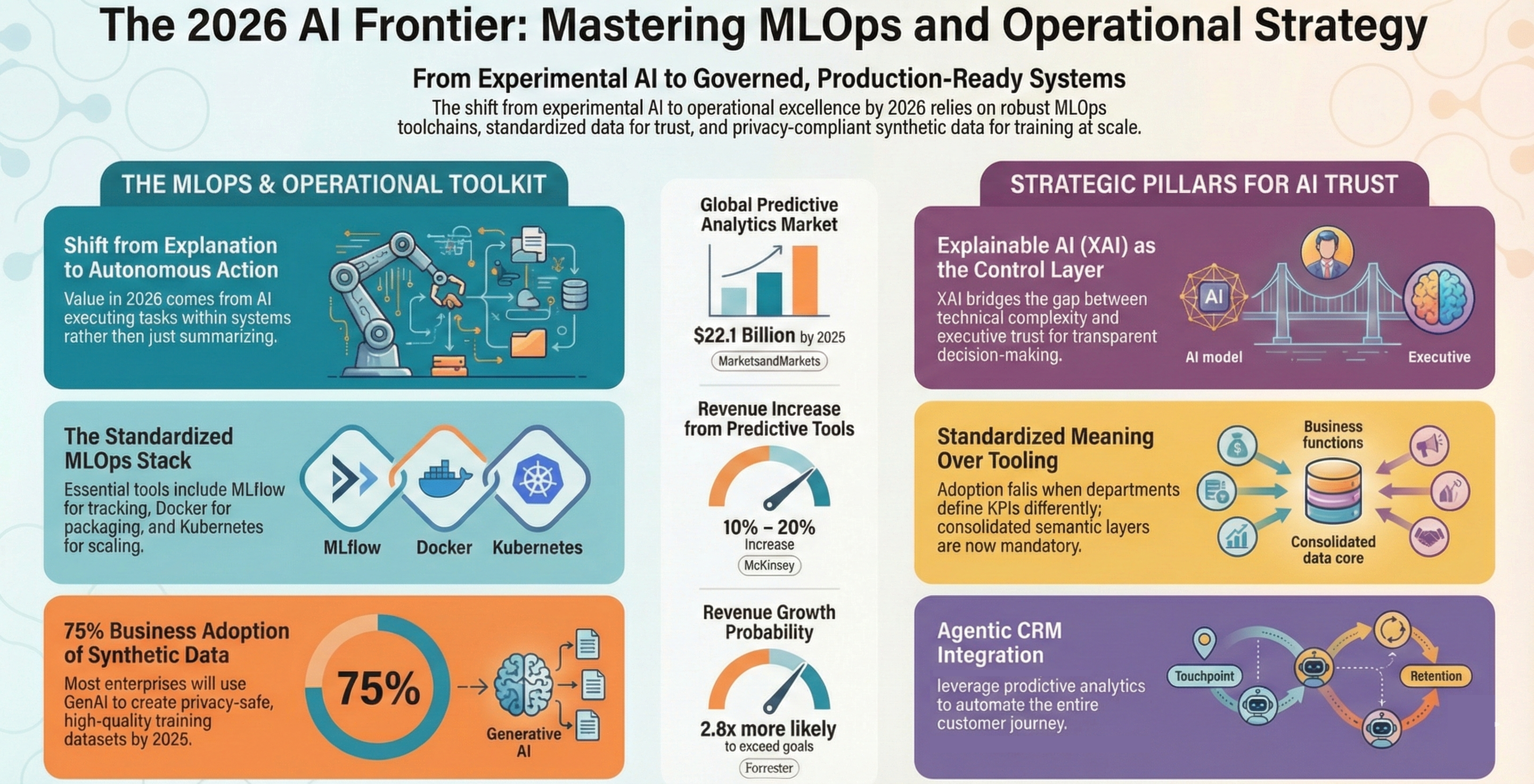
Every business wants to know what happens next. We used to rely on historical data to guess the future, but AI has turned forecasting into core infrastructure. The market for these tools continues to grow, but a strange dynamic has taken hold. We have software that can spot a trend in seconds, but we put it inside organizations that take weeks to schedule a meeting about it. Finding the insight is the easy part. The actual bottleneck is finding a way to act on it before the window closes.
From prediction to agency
Machine learning models excel at finding weird, non-linear patterns that standard statistical methods miss. They also handle messy data without breaking a sweat. We are currently moving past systems that just tell us what will happen. The new focus is agentic AI. Instead of just flagging a supply chain risk, an agentic system can draft the emails to secondary suppliers and prep the purchase orders. Research firms claim this level of automation boosts revenue, though the real value is simply moving faster than humanly possible.
How industries are adapting
You can see this shift happening across major sectors. Retailers like Amazon and Walmart have moved past basic inventory math. They feed weather patterns and social media sentiment into multimodal models to predict demand, which cuts down on both empty shelves and warehouse bloat. Financial institutions traded static credit scores for real-time risk assessment years ago. JPMorgan Chase uses predictive models to catch fraud, and algorithmic traders use them to execute trades in milliseconds. In healthcare, the focus is on catching problems early. Some models can identify patients at high risk for diabetes long before they show clinical symptoms. Hospitals are also using ambient speech AI to handle documentation, letting doctors actually look at their patients instead of a screen.
The organizational bottleneck
The tech stack is rarely the problem anymore. The barrier is organizational friction. When marketing, sales, and support do not talk to each other, a real-time prediction is useless. Companies are trying to fix this by standardizing their data. They are adopting tools like the Model Context Protocol to connect AI systems to internal data more easily. They are also building governed semantic layers. If marketing and sales do not agree on the definition of a "lead," no predictive model is going to save them.
The 'black box' problem
As we hand more decisions over to algorithms, the fact that we cannot easily explain how they work becomes a massive liability. You cannot deny a loan or diagnose a disease and just tell the person that the computer said so. Engineers are using techniques like LIME and SHAP to look under the hood and figure out exactly which variables triggered a specific prediction.
Privacy is another headache. To get around strict data regulations, companies use synthetic data. These fake datasets mirror the statistical shape of real medical or financial records without containing anyone's actual personal information.
What comes next
Predictive analytics will only get faster and more autonomous. Researchers are already looking at quantum-enhanced models to simulate materials and solve logistics problems that choke classical computers. But none of that matters if your company cannot get out of its own way. An advanced AI model is not a competitive advantage if it takes your team a month to approve the changes it suggests. The companies that survive the next few years will be the ones that fix their internal plumbing so they can actually use the data they are paying to analyze.
Sources include:
Technology Trends Outlook, McKinsey
What is Explainable AI (XAI)?, IBM
AI Data Analytics Trends 2026, Techment