
Artificial Intelligence (AI) is no longer a futuristic concept reserved for tech giants; it is a transformative force currently revolutionising how businesses of all sizes operate across the United Kingdom and beyond. For Small and Medium-sized Businesses (SMBs), the acceleration of AI adoption offers unprecedented opportunities for efficiency, yet it simultaneously presents a unique set of ethical challenges that require authoritative, proactive governance. Capturing the full value of AI whilst avoiding its potential pitfalls demands a delicate balance between innovation and accountability.
The Regulatory Landscape: Risk and Responsibility
The regulatory environment for AI has shifted rapidly from voluntary guidelines to mandatory legal frameworks. For UK businesses, the National AI Strategy takes a sector-specific, principle-based approach, empowering existing regulators like the Information Commissioner’s Office (ICO) to oversee applications within their domains. However, any SMB operating across borders must also be mindful of the EU AI Act, which classifies AI systems into four risk levels. Applications deemed "high-risk", such as those used in recruitment, education, or essential services, are subject to strict requirements regarding data governance, transparency, and human oversight.
Algorithmic Bias: Lessons from the Giants
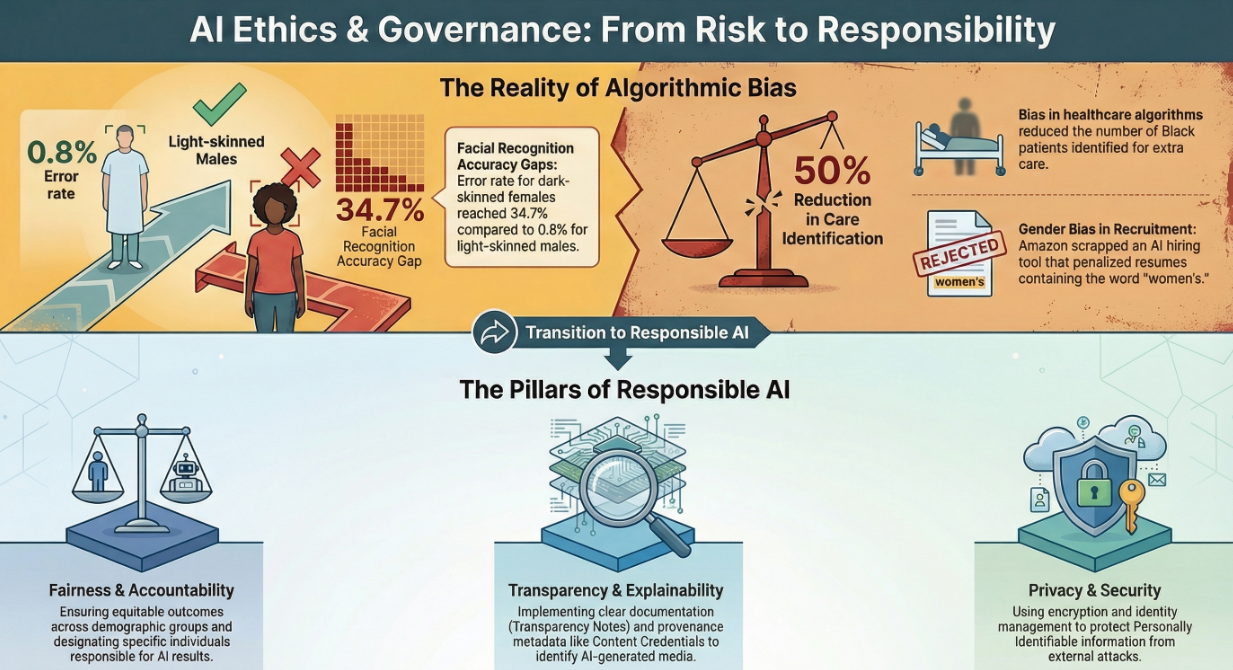
AI systems are only as good as the data they are provided; they often replicate and amplify societal prejudices embedded in training datasets. SMBs must learn from the failures of larger organisations to avoid significant legal and reputational damage. For instance, Amazon was forced to scrap an AI recruitment tool after it was found to penalise resumes containing the word "women’s," as it had been trained on a decade of predominantly male hiring data. Similarly, financial algorithms have faced scrutiny for offering lower credit limits to women compared to their spouses, even when they possessed higher credit scores. To mitigate these risks, businesses should adopt the "four-fifths rule" to assess if selection rates for protected groups differ significantly from others. Implementing tools such as IBM’s AI Fairness 360 or Microsoft Fairlearn can help data teams detect and remediate these biases before they reach the customer.
Data Privacy in the Age of Data Capitalism
The collection of massive amounts of personal data has birthed a form of "data capitalism," where personal information is exploited for commercial gain. For SMBs, which may lack the robust governance frameworks of multinationals, the ethical imperative is to ensure informed consent and data protection. Large Language Models (LLMs) often rely on data scraped from the internet without explicit user consent. Ethical practice dictates that businesses should be transparent about what data is gathered, give users the choice to opt out, and consider using synthetic data to protect privacy.
The Human Element: Redefining the Workforce
One of the most pressing concerns for employees is the risk of job displacement. Estimates suggest that up to 47% of jobs could be at risk of automation, particularly in manufacturing and retail. However, forward-thinking SMBs should view AI as an opportunity for augmentation rather than replacement. By automating routine, repetitive tasks, AI can elevate human workers, allowing them to focus on high-value activities requiring emotional intelligence, complex problem-solving, and creativity. This transition requires a commitment to re-skilling and up-skilling programmes to ensure a fair transition for the workforce.
Transparency and the 'Black Box' Problem
AI algorithms are often perceived as "black boxes" whose internal mechanisms are a mystery even to their creators. In high-stakes environments like healthcare or finance, this lack of explainability erodes trust. SMBs should prioritise Explainable AI (XAI), ensuring that decisions affecting customers or employees can be articulated in understandable terms. Trust is the backbone of the digital economy; if users do not understand or trust a model, the business cannot truly benefit from it.
Environmental Stewardship
The computational power required to train and run complex AI models is immense, contributing significantly to carbon emissions and environmental degradation. Training a single large AI model can produce as much carbon dioxide as five average cars over their entire lifetime. SMBs can mitigate their environmental footprint by selecting energy-efficient models, training on smaller datasets, and using data centres powered by renewable energy.
Implementing a Governance Framework
To navigate these complexities, SMBs should establish a dedicated governance strategy overseen by the board of directors. This includes:
Conclusion
For SMBs, ethical AI is not merely a box-ticking exercise for compliance; it is a strategic imperative for sustainable growth. By embedding values like fairness, transparency, and accountability into their implementation strategy, businesses can build enduring trust with stakeholders and contribute positively to society. As the AI era matures, the organisations that thrive will be those that align their innovation with the core values of human dignity and social responsibility.
Sources include:
Responsible AI Transparency Report, Microsoft
10 AI dangers and risks and how to manage them, IBM
AI and the Role of the Board of Directors, Harvard Law School