
Practical guide for UK SMEs on adopting AI automation

AI Automation and High ROI Use Cases Infographic

Sixth post in our 'Discover AI' Blog Series.
June 2026

If you are a business leader in the UK feeling a bit overwhelmed by the relentless chatter about artificial intelligence, you are far from alone. Many small and medium-sized enterprises (SMEs) are currently in a transition phase; acutely aware that AI is the future, but struggling to identify exactly where to start.

It is entirely normal to feel hesitant about overhauling the processes that have kept your business running for years. However, the goal of modern technology is not to replace your team, but to remove the friction from their daily operations. This guide provides a practical, straightforward roadmap for adopting ai automation for business, allowing you to step away from the hype and focus on tangible, high-value results.

What is AI Automation?
Before diving into strategies, we must address a fundamental question: what is AI automation? It is easy to confuse AI with simple generative chatbots, but automation goes much further. AI automation is the integration of intelligent software to handle repeatable, rule-based tasks, such as moving data between applications, processing supplier invoices, or answering routine customer queries without requiring a person to execute every manual step. Instead of treating AI as a novelty that simply drafts emails, treating it as an automation engine allows you to build digital workflows that operate flawlessly in the background.

The Phased AI Adoption Approach
A successful SEO and operational strategy relies on a sustainable "AI adoption approach". The biggest mistake UK SMEs make is attempting to digitise everything at once. A far more effective strategy is to start small. By focusing on highly structured, predictable processes first, you minimise risk and allow your team to build trust in the technology. Once the first automated workflow proves its value, you can reinvest the time and capital saved into more complex areas of the business.

Practical AI Automation Use Cases & Examples
When identifying the best AI automation use cases, the secret is to look for the mundane. If a task requires copying and pasting, matching numbers, or answering the same questions repeatedly, it is a prime candidate. Here are three high-ROI AI automation examples that are currently transforming UK businesses:

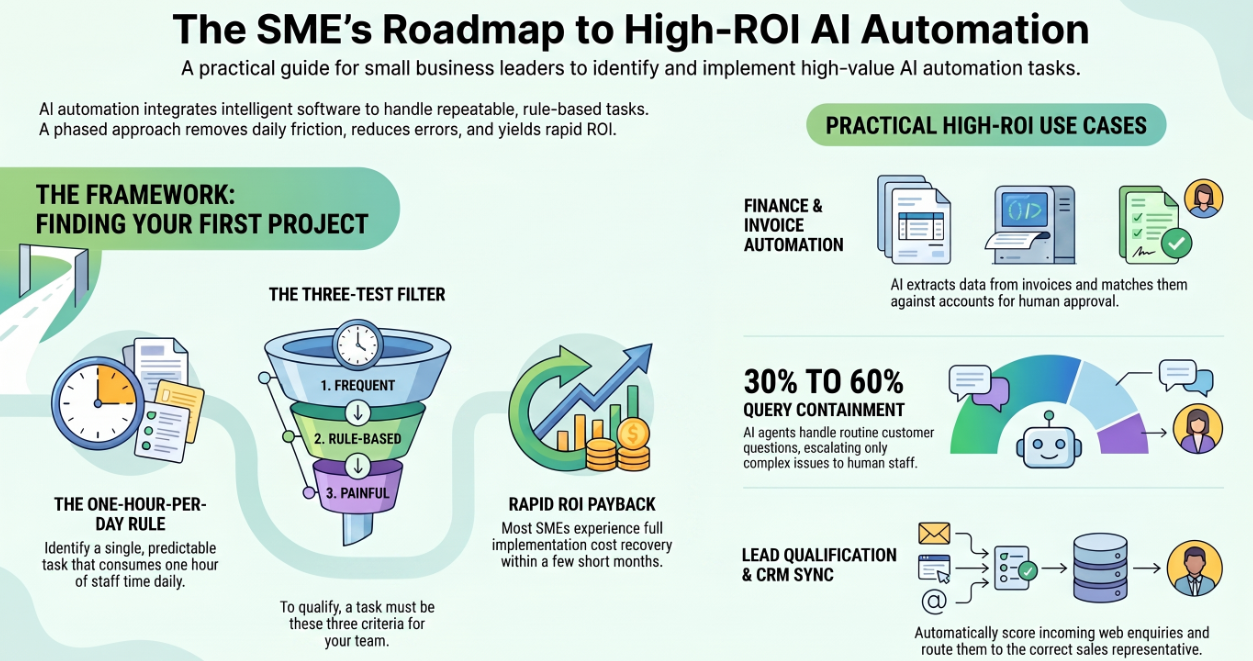
  1. Invoice Processing & Finance Automation: Finance is arguably the highest-ROI starting point. Rather than having a staff member manually key in purchase ledger details, an AI agent can extract line items and VAT figures from PDF invoices, match them against a chart of accounts, and draft a bill for final human approval.

  2. Customer Support and Queries: Implementing an AI support agent is no longer a luxury reserved for tech giants. A well-trained automation can handle 30% to 60% of basic incoming queries (e.g., return policies, delivery updates, and password resets) instantly, escalating only the nuanced or complex issues to your human team with the full context already gathered.

  3. Lead Qualification: Instead of sales teams spending hours logging interactions, AI automation can instantly read incoming web enquiries, score the lead against your ideal customer profile, and either automatically route them a calendar link to book a call or flag them for a junior representative to nurture.

The Framework
To make this advice immediately actionable, we recommend using a simple filtering system to find your first project: the "one painful one-hour-per-day task" framework. Ask yourself and your department heads: “What is one predictable, rule-based task that takes an hour out of your day, every single day?”. To qualify for your first automation project, the task must pass three tests:

By isolating just one task that meets these criteria, you create a low-risk, highly measurable test case for your business.

Analysing AI Automation Benefits and ROI
The overarching AI automation benefits extend far beyond mere convenience. By automating routine operations, SMEs experience drastically reduced manual error rates, improved compliance, and happier teams who are empowered to focus on relationship-building and strategy. But what about the bottom line? When we discuss AI automation ROI, the numbers speak for themselves. According to recent UK market data, SMEs typically see a return on investment payback within an incredibly short period—often just three to six months. Because automation tools operate around the clock without fatigue, a well-scoped project (such as automating a 10-hour-a-week administrative bottleneck) pays for its implementation costs rapidly, delivering pure cost savings and productivity gains for every year that follows. Ready to start? Pick your one painful task today, map out the steps on a piece of paper, and begin exploring the tools that can take it off your desk tomorrow.

Sources include:
Half of SMEs Using AI, British Chamber of Commerce
What does firm-level data tell us about AI adoption in the UK?, University of Cambridge
Agents, inovation, and transformation, McKinsey